First Year Of Online Voting Was Rocky For Academy

Pete Hammond is Deadline’s awards columnist. This article appeared in the Feb. 13 issue of AwardsLine.

This year the big question hasn’t been exactly who Academy of Motion Picture Arts and Sciences members are going to vote for, it has been instead whether they can figure out how to vote at all.

With the advent of online voting for the first time in Academy history, the path during the nomination balloting hasn’t been a smooth one for many voters. Some found that the Academy’s security steps, necessary to avoid hackers, have also kept voters out, forcing them to make repeated attempts at getting their ballot completed.

Poll_positionAlthough all the guilds and other voting groups have moved full force into the world of online voting, the Academy went through a slow, methodical process before finally settling on Everyone Counts, a company known for working with the U.S. government in a similar capacity. Unlike most industry groups, the Academy is a prime target for infiltration by cyber terrorists who would like nothing more than to gain access to vote totals and embarrass the high-profile Oscar process, which in 85 years has never been compromised.

But keeping voting hacker-proof caused its own set of issues, when in November the Academy had to extend its registration period after member complaints. After that, AMPAS also backed down and agreed to send an old-fashioned paper ballot to any member who had paid their dues but hadn’t bothered or didn’t know how to register for online voting. All along, the Academy offered paper ballots as an alternative but initially had required a one-time registration for those as well—something longtime members used to getting ballots in the mail automatically didn’t realize.

Many voters said they were able to vote online with no problems, but a large and very vocal group complained that they were locked out of the system and had to spend valuable time trying to vote over the course of two or three days.

Although the Academy sent out repeated email reminders, provided a ’round-the-clock phone number for member support, and set up kiosks in the lobby of its Beverly Hills headquarters, some members experienced great frustration. However, as president Hawk Koch told me on the morning of the Oscar nominations, the turnout was still the largest the Academy had seen for nominations in several years. But he also said nothing was perfect on a first try. And before final voting began on Feb. 8 (ballots are due back on Feb. 19), the Academy sent members a detailed—some might say too complex—guidebook on how to accomplish online voting. The Academy also sent out emails offering the option of a paper ballot to anyone who wants one. From my admittedly nonscientific sample survey, a lot of members took them up on the offer by the deadline of Feb. 1.

For those determined to enter the brave new world of electronic Oscar voting, the Academy told them they will need four things: 1) A voter identification number; 2) A voting password (not to be confused with their member password and one that must contain a mix of letters, numbers, and a special character); 3) A security code; and 4) A telephone where voters will receive their special code by text after entering their VIN and password.

The Academy’s E Voter Guide then takes the voter step by step into how to actually cast their ballot once they have successfully logged into the system in the first place. Some members told me it took them two or three tries after getting locked out for a 24-hour period to actually finish the task during nominations. If you try a password too many times, and it doesn’t work, you have to call the Academy support line to get a new one.

Certainly Academy officials, who took great care before embarking on this new adventure for Oscar, are hoping this will get easier with time. It took the Screen Actors Guild seven years before they were comfortable that it was running smoothly enough to eliminate paper ballots. The Academy is dealing with a membership that might not be so tech savvy. But for an organization that is such a tempting target for hackers, it is not an easy task, and the option of paper ballots will probably be around for a long time. “Please tell them, just send me a paper ballot. I’m begging,” one Oscar-nominated longtime member told me.

The bottom line is, if you want to vote, you will be able to vote. “What I can say is, we will not jeopardize the integrity of the Oscar ballot. We will make sure that everybody can vote,” Koch told me.

This Year’s Race Parallels 1962

Pete Hammond is Deadline’s awards columnist. This article appeared in the Feb. 13 issue of AwardsLine.

Many have said 2012 has been the most remarkable year for movies in the Oscar race in a very long time. The dense list of quality contenders makes for quite a race, and it’s somewhat reminiscent of another legendary year for cinema a half-century ago.

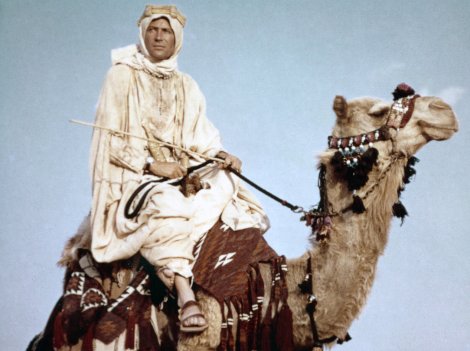
Peter O'Toole in Lawrence of Arabia.
Peter O’Toole in Lawrence of Arabia.

The year 1962 was an embarrassment of riches, and in many ways, just an embarrassment for the Academy. Yes, they did include the year’s two best films, To Kill a Mockingbird and (eventual winner) Lawrence of Arabia, in the best picture lineup and both have endured as certified classics. Both were worthy. But then the Academy padded out the remaining three spots with popular studio offerings like The Longest Day, The Music Man, and most egregiously, the bloated Marlon Brando remake of Mutiny on the Bounty. OK, these films might have been decent entertainment, but were they the best the Academy could do 50 years ago? Hardly.

Just consider the films that didn’t make the cut: Blake Edwards’ Days of Wine and Roses; John Frankenheimer’s The Manchurian Candidate, Birdman of Alcatraz, and All Fall Down; Arthur Penn’s The Miracle Worker; Robert Aldrich’s What Ever Happened to Baby Jane?; Otto Preminger’s Advise & Consent; Stanley Kubrick’s Lolita; John Ford’s The Man Who Shot Liberty Valance; David Miller’s Lonely Are the Brave—and this is just a partial list! Was it because all these films were in black and white? Well, so were Mockingbird and Longest Day, so that doesn’t explain it. Were they too challenging when compared to the populist films that made the cut instead? The point is, we are still seeing, experiencing, and talking about most of the best picture also-rans today. They have stood the test of time, a feat perhaps greater than ever being nominated for a best picture Oscar.

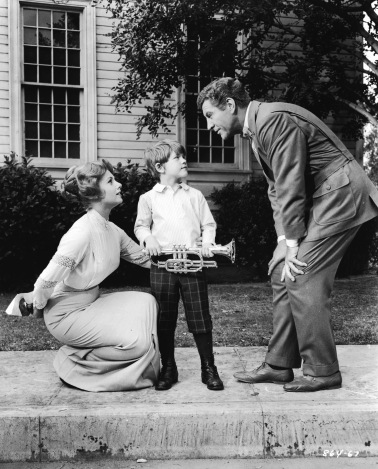
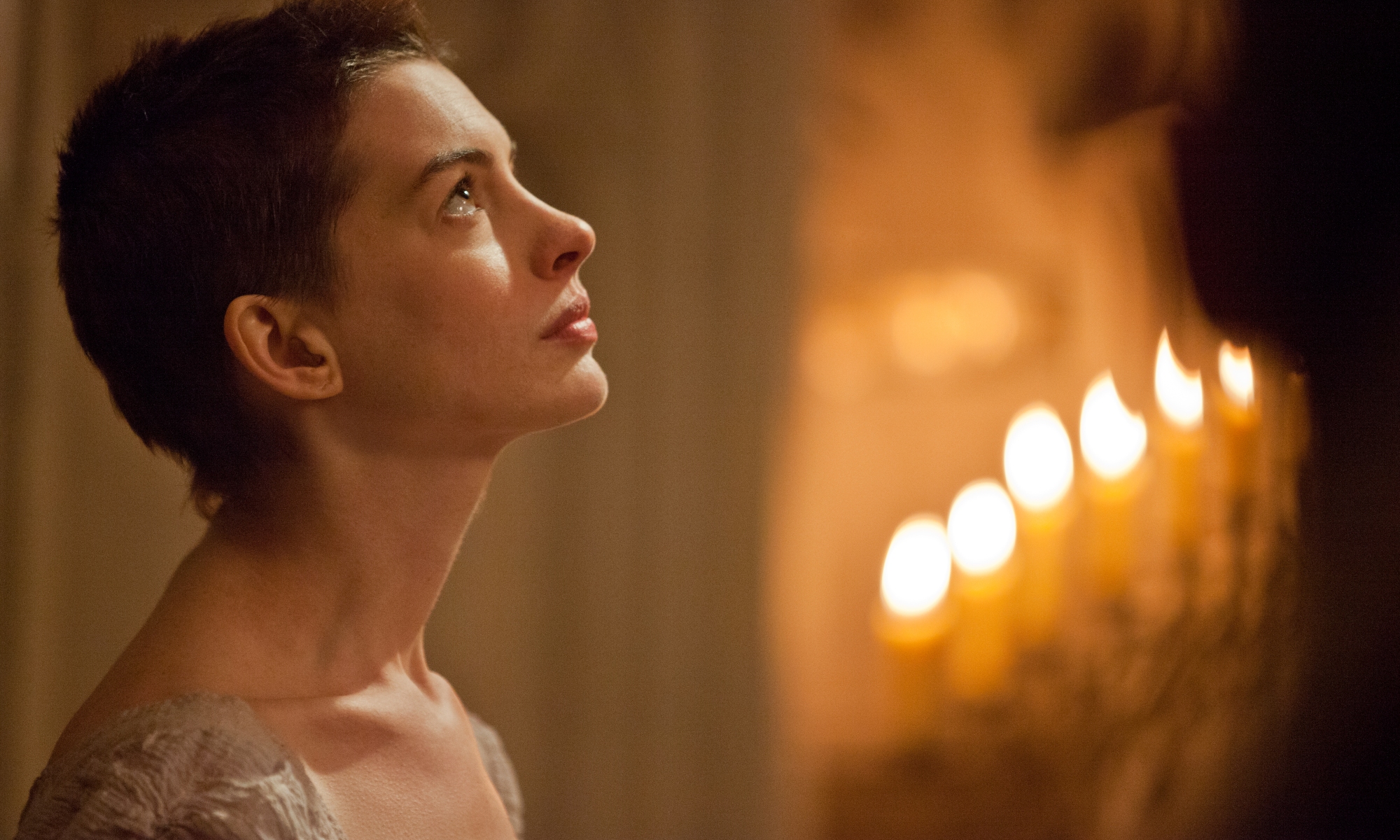
The Music Man earned a best picture nomination, but like Argo, Les Miserables, and Zero Dark Thirty, it failed to earn a best director nom.

It is interesting to note that, just as the Academy has done this year in failing to nominate the directors of best picture nominees Argo, Les Misérables, and Zero Dark Thirty, the Academy’s directors branch of 1962 was just as prickly and contrarian in ignoring the directors of three best picture nominees (Longest Day, Mutiny, and Music Man) in favor of smaller entries like David and Lisa, The Miracle Worker, and the foreign language Italian film Divorce Italian Style, which like this year’s Austrian/French Amour also nabbed nominations for acting and writing, winning for the latter just as Amour could do. The directors of those best picture also-rans were every bit as worthy of the nomination they didn’t get (Frankenheimer’s three 1962 classics should have gotten him a nod just based on volume alone). Some things never change. And, quite frankly, considering the advanced age of some Academy members, many of the same people are still doing the voting.

The year 1962 was also when James Bond was introduced to the movies in Dr. No starring Sean Connery, still one of the best of the Bonds, yet it didn’t merit a single nomination back then. In fact, Bond has been consistently ignored throughout the past 50 years, with just a handful of technical nominations and awards. A half-century from the time Bond was introduced, it seemed like it was all going to change this year with Skyfall, which was poised to become the first Bond ever to earn a best picture nom. It didn’t happen, just like it didn’t happen 50 years ago. At least the Academy has been guilted into a special tribute to recognize this most successful—and brilliant—of all movie franchises.

Beyond best picture, which did at least go to a very deserving winner in David Lean’s Lawrence of Arabia, the acting races across the board were gut-wrenching cliffhangers. I can’t recall the four categories to ever be so competitive as they were that year. For best actor, try to choose among Gregory Peck in To Kill a Mockingbird, Peter O’Toole in Lawrence of Arabia, Jack Lemmon in Days of Wine and Roses, Marcello Mastroianni in Divorce Italian Style, and Burt Lancaster in Birdman of Alcatraz. If it weren’t for Peck’s iconic Atticus Finch, which deservedly won, certainly O’Toole would have triumphed the first time out for his glorious T.E. Lawrence instead of going zero for eight and becoming Oscar’s most losing actor (thank God they finally gave him an honorary award).

Best actress was an imposing quintet with Bette Davis in a shocking comeback role, Lee Remick as a drunk, Geraldine Page as a fading film star, Katharine Hepburn doing Eugene O’Neill, and the winner, Anne Bancroft, training the blind Helen Keller. Pre-Oscar bets from Hollywood experts were on each and every one to prevail. There were duo Oscar upsets in the supporting races, too. Virtually everyone thought Lawrence’s Omar Sharif would win, but he was upstaged by a career nod to Sweet Bird of Youth’s Ed Begley. And in supporting actress, it was Angela Lansbury as Laurence Harvey’s conspiratorial and chilling mother in The Manchurian Candidate who was seen as a sure thing, only to be passed over for 16-year-old Patty Duke as Helen Keller in The Miracle Worker. It was the criminally overlooked Lansbury’s to lose—and she did, never getting another shot. Oscar fans are still smarting, though Duke’s performance still holds up.

Sometimes Oscar races leave lasting scars. It’s about what could have been. And in a year as good as 2012 was, will we still be arguing the outcome 50 years from now just like we still do about ’62?

Oscarcast Producers Want To Honor Tradition And Modernize Ceremony

Pete Hammond is Deadline’s awards columnist. This article appeared in the Feb. 13 issue of AwardsLine.

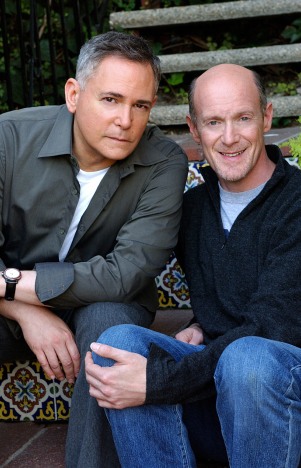
Oscar telecast producers Craig Zadan and Neil Meron know their stuff when it comes to putting on a show. With huge musical successes in movies (Chicago, Hairspray, Footloose), TV (The Music Man, Cinderella), and Broadway (Promises Promises, How to Succeed in Business Without Really Trying), they have the chops to pull off the film industry’s biggest night of the year, though it has sometimes proved a pitfall for other producers. It can be challenging when the Academy mandates that valuable airtime goes to all 24 categories, including sound mixers, makeup and hairstylists, and producers of documentary short subjects, to name a few. But that doesn’t faze this veteran producing pair who say they started assembling the show’s elements from the day they got the job in late August.

Oscar telecast producers Craig Zadan and Neil Meron say they have been working on the show since they were appointed in August.

“We certainly are going to be celebrating the nominees and winners like a regular Oscar show, but they are fitting into the design of the show that we’ve created, so there’s going to be an enormous amount of entertainment,” Zadan says, pointing to the 50 years of James Bond tribute they have announced, which won’t be a reunion of the actors who played 007 despite rampant media speculation. “It’s something else, something very unique and very exciting but no, we’re not getting the Bonds together.”

Among other entertainment spots planned is a tribute to the movie musicals of the past decade, including this year’s best picture contender Les Misérables, Dreamgirls (I hear with Jennifer Hudson performing), and the producers’ own best picture champ, Chicago. And singing on an Oscar show for the first time in 36 years will be Barbra Streisand. My bet is she’ll sing “The Way We Were” in honor of its late composer Marvin Hamlisch, though the producers are not offering specifics on that one.

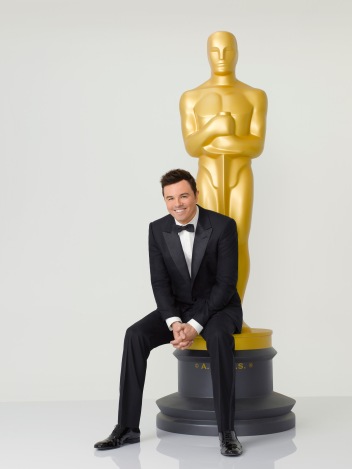
Both producers say they’re eagerly anticipating seeing first-time host Seth MacFarlane take the stage. “He has great charm. He embodies kind of a post-millennium host in that tradition of Johnny Carson, Bob Hope, and Billy Crystal. He is the next step in terms of making the show current,” Meron says about the reason why the Family Guy and Ted creator got the job.

In fact, MacFarlane’s oversized teddy bear Ted has already confirmed an appearance on the telecast alongside his costar Mark Wahlberg. In addition to being a first-time host, MacFarlane is a first-time nominee as cowriter of Ted’s main title song, “Everybody Needs a Best Friend.” Norah Jones will sing it on the show, as the producers have also decided to bring back the tradition of having all five nominated tunes sung live. Among them, pop superstar Adele will be singing the hit nominee “Skyfall” and performing on television for the first time since she swept the Grammys a year ago.

Don Mischer, 15-time Emmy winner and a producer of the Oscars for the past two years, is returning to direct. “If you can put entertainment around the awards and maintain the dignity of the Academy, or put some humor and a little bit of irreverence around it, you can make it more entertaining, and it makes for a better show. I think (Zadan and Meron) are really on track to do that,” Mischer says.

Family Guy and Ted creator Seth MacFarlane will host the Oscars for the first time this year.

Academy president Hawk Koch, who hired the producing pair, says they have gotten rid of a lot of what he calls “shoe leather.” “We are going to present all the categories, but between Craig and Neil and I, we have found a way to move it along,” he says.

There’s added pressure this year because of the well-reviewed performance of Golden Globes hosts Tina Fey and Amy Poehler, which help push ratings up 24% compared to last year. The Academy certainly does not want to come up short in comparisons with that NBC show.

As for MacFarlane, he has a good attitude even though reviews of his “performance” hosting the Academy nominations announcement with Emma Stone were decidedly mixed. Some Academy members thought he went too far with his jokes, others thought it wasn’t appropriate to mock nominees just as they were becoming known for the first time. “It’s a ruthless bit of scrutiny you’re under, so I’m not going to think about that. I’m just worrying about making it as funny as it can be and as fun as it can be,” MacFarlane said shortly after the nomination announcement.

For Zadan and Meron, however, it’s all about putting on the best show possible. In preparation, Meron says he watched 40 previous Oscar telecasts. He has great respect for the producers and what they tried to do. “What I learned is that (past) producers of the show really took chances and shook things up all through the course of Oscar history,” he explains. “It really is a great tradition to be a part of.”

Moments In Oscar History, Part 3: The Directors

In honor of the 85th Academy Awards, AwardsLine is spotlighting memorable moments and winners from the last eight decades. This is the final installment, Part 3: The Directors.

Frank CapraFrank Capra, 1939: The 11th Academy Awards took place Feb. 23, 1939, in downtown Los Angeles’ Biltmore Hotel. Although no specific emcee steered the ship, the evening began with a rendition of “The Star-Spangled Banner,” and Basil Rathbone introduced Frank Capra as president of the Academy. Just days before, Capra had threatened to resign and boycott the ceremony in an effort to get the studios to recognize the Screen Directors Guild. He ended up prevailing over Motion Picture Producers Association president Joe Schenck—going so far as to follow him to Santa Anita Racetrack after Schenck missed a scheduled meeting. Capra’s film You Can’t Take It With You won picture and directing prizes; Spencer Tracy (Boys Town) and Bette Davis (Jezebel) won lead acting prizes; and supporting honors went to Walter Brennan for Kentucky and Fay Bainter for Jezebel.

“My third Oscar for best directing left me so stunned, I remember little of my ‘thank you’ mumblings. The rest of the program was a blur. But when Jimmy Roosevelt opened the best picture envelope and broke the suspense with, “And the best picture of the year is You Can’t Take It With You!”, my poor numbed brain tail-spinned into total amnesia.

“The crazy events of the past week: Chasing Joe Schenck to the racetrack; the strike vote, my resignation and boycott of the Academy; the last-minute producers’ agreement that called them off, that put the Directors Guild in business; the whole wonderful Academy Banquet that climaxed in my third best director and my second best picture Oscars—these were the events that simply reaffirmed a lifelong belief: Everything that happens to me happens for the best.”—Frank Capra on his Oscar wins, from his 1971 autobiography The Name Above the Title. His previous wins were for 1934’s It Happened One Night and 1936’s Mr. Deeds Goes to Town.

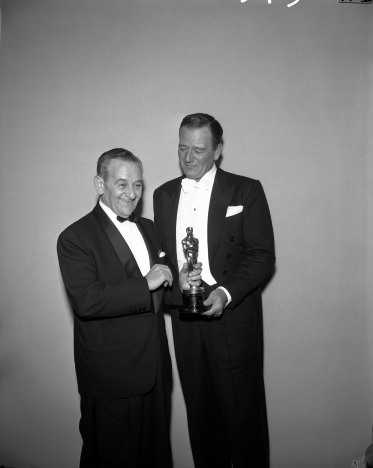
William WylerWilliam Wyler, 1960: The 32nd Academy Awards took place April 4, 1960, at the Pantages Theater in Hollywood and was hosted by Bob Hope. MGM’s Ben-Hur won 11 of the 12 Oscars for which it was nominated, including picture and director for William Wyler, lead actor for Charlton Heston, and supporting actor for Hugh Griffith. It was the second year in a row that the Culver City studio took home best picture after previously winning for Gigi, and Ben-Hur broke the record of most Oscars in a single evening. Lead actress honors went to Simone Signoret—the first actress to win for a foreign film—for Room at the Top, while the supporting Oscar was awarded to Shelley Winters for The Diary of Anne Frank.

“My deepest appreciation to Sam Zimbalist and Joe Vogel for their confidence, and to my fellow members of the Academy for this [raising the Oscar]. Thank you.”—William Wyler (left, with John Wayne) earned his third career Oscar for directing Ben-Hur. His previous directing wins were for 1942’s Mrs. Miniver and 1946’s The Best Years of Our Lives.

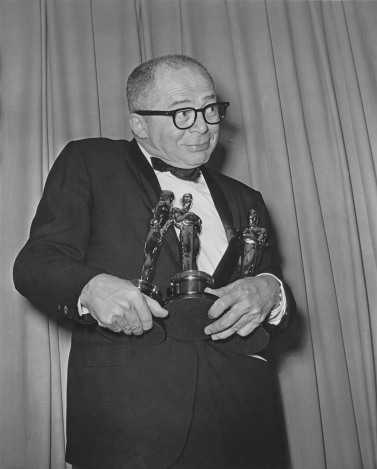
Billy Wilder backstage at the 1960 (33rd) Academy Awards ceremony.Billy Wilder, 1961: The 33rd Academy Awards took place April 17, 1961, at the Santa Monica Civic Auditorium, with the ever-present Bob Hope serving as emcee. It was the first time the show had taken place outside of Los Angeles or Hollywood in three decades. The ceremony also marked the beginning of ABC’s half-century association with the Oscars, with ABC winning broadcast rights to the show. Billy Wilder won picture and director Oscars for The Apartment, though neither of his nominated actors, Shirley MacLaine nor Jack Lemmon, earned trophies. Best actor was Burt Lancaster, and supporting actress was Shirley Jones, both for Elmer Gantry; lead actress went to Elizabeth Taylor for Butterfield 8; and supporting actor was Peter Ustinov for Spartacus.

“Thank you so much, you lovely discerning people. Thank you.”—Billy Wilder accepting his directing trophy for The Apartment, which earned a total of five Oscars that night. Wilder also won the Irving G. Thalberg Memorial Award in 1987 at the 60th Academy Awards.

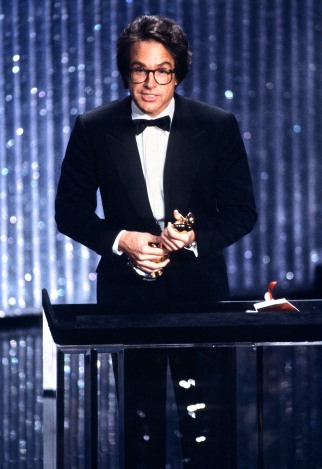
Warren Beatty 2Warren Beatty, 1982: The 54th Academy Awards were held March 29, 1982, at the Dorothy Chandler Pavilion, hosted by Johnny Carson, who had held the reins since 1979. The two major prizes were split, with Chariots of Fire earning best picture and Warren Beatty winning for directing Reds, a film that some thought would win both awards. Henry Fonda won best actor for On Golden Pond, though he was too frail to attend the ceremony; Katharine Hepburn won her fourth Oscar for her lead in the same film; John Gielgud won a supporting trophy for Arthur; and Maureen Stapleton won for her supporting role in Reds. After thanking two other nominees, Jack Nicholson and Diane Keaton, in his acceptance speech, Beatty turned his attention to the studio executives who greenlit his film.

“I do want to name Mr. Barry Diller who runs Paramount, Mr. Dick Zimbert who’s been very kind to me, Mr. Frank Mancuso, and Mr. Charles Bluhdorn who runs Gulf + Western and God knows what else. And I want to say to you gentlemen that no matter how much we might have liked to have strangled each other from time to time, I think that your decision, taken in the great capitalistic tower of Gulf + Western, to finance a 3½-hour romance which attempts to reveal for the first time just something of the beginnings of American socialism and American communism, reflects credit not only upon you, I think it reflects credit upon Hollywood and the movie business wherever that is. And I think that it reflects more particular credit on the freedom of expression that we have in our American society and the lack of censorship that we have from the government or the people who put up the money. Thanks.”—Warren Beatty accepting his directing trophy for Reds. He also took home the Irving G. Thalberg Memorial Award in 1999.

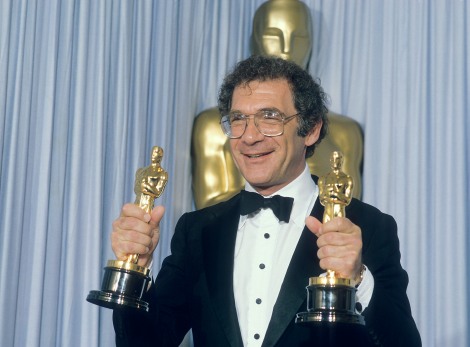
Sydney Pollack backstage at the 1985 (58th) Academy Awards ceremony.Sydney Pollack, 1986: The 58th Academy Awards took place March 24, 1986, at the Dorothy Chandler Pavilion, with Jane Fonda, Alan Alda, and Robin Williams serving as hosts. Sydney Pollack’s Out of Africa won seven Oscars out of 11 total nominations, a virtual sweep, although neither of its nominated leads—Meryl Streep nor Robert Redford—won for their roles. Lead actor honors went to William Hurt for The Kiss of the Spider Woman, and lead actress was Geraldine Page for The Trip to Bountiful. Don Ameche earned the supporting actor Oscar for Cocoon, while Anjelica Huston took home a supporting actress trophy for Prizzi’s Honor.

“Thank you very much. Frank Price made this film possible. He had the courage when it mattered the most and was easy to say no. I knew it was impossible to get a screenplay from this material, so I didn’t try; Kurt Luedtke didn’t know it was impossible and so he did it. David Rayfiel kept us honest. Meryl, Bob, Klaus, and Malick brought those characters to life and made an incredible world. All of us being helped all the time by Terry Clegg who kept us going. I had a team of editors who locked themselves in a room with me seven days a week, 12 hours a day and behaved as though nothing else in the world existed. John Barry made it all sing. Karen Blixen lived that life and turned it into art and taught a generation a new way to write prose. My wife, Claire, gave me more encouragement than I have any right to have, put up with more, was more tolerant. I’m indebted to all of them. I can’t leave this podium without saying, I could not have made this film without Meryl Streep. She is astounding personally, professionally, in all ways, and I can’t thank her enough. Thank you.”—Sydney Pollack accepting his directing Oscar for Out of Africa, for which he won a second producing trophy that same evening when the film was named best picture.

Moments In Oscar History, Part 2: Actors & Actresses

In honor of the 85th Academy Awards, AwardsLine is spotlighting memorable moments and winners from the last eight decades. This is Part 2: Actors & Actresses. Part 3 will be The Directors.

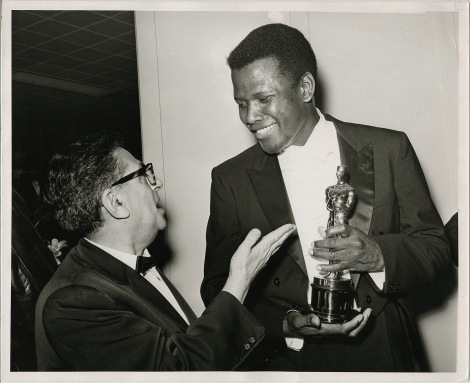
Sidney Poitier (actor), Sidney Skolsky1963 (36th)Sidney Poitier, 1964: Academy Award winner Jack Lemmon hosted the 36th Academy Awards, which took place April 13, 1964, at the Santa Monica Civic Auditorium. Though the Academy still rarely awards comedies, best picture and director honors went to Tony Richardson’s Tom Jones. Hud claimed two of the acting trophies, for lead actress Patricia Neal and supporting actor Melvyn Douglas, while Sidney Poitier was best actor for Lilies of the Field and Margaret Rutherford was supporting actress for The V.I.P.s. Among the acting winners, only Poitier was on hand to accept his statuette at the ceremony.

“Because it is a long journey to this moment, I am naturally indebted to countless numbers of people, principally among whom are Ralph Nelson, James Poe, William Barrett, Martin Baum, and of course, the members of the Academy. For all of them, all I can say is a very special thank you.”—Sidney Poitier accepting his first Oscar for Lilies of the Field. He won a second honorary Oscar in 2001.

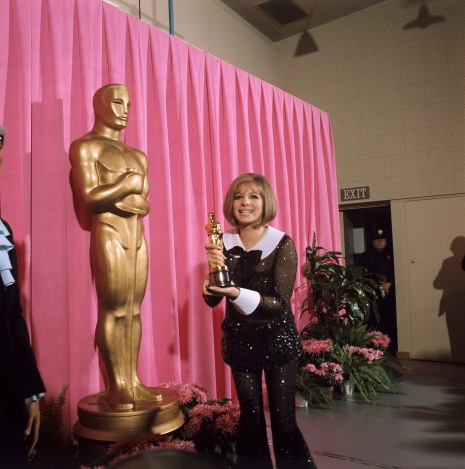
Barbra StreisandBarbra Streisand, 1969: The 41st Academy Awards took place April 14, 1969, at the Dorothy Chandler Pavilion, with a group of 10 hosts that included Ingrid Bergman, Sidney Poitier, and Burt Lancaster. The best picture Oscar went to Oliver!, and its director Carol Reed also took home a statuette. Cliff Robertson won the lead actor trophy for Charly, but the actress category was a tie—the second in Oscar history—between Katharine Hepburn for Lion in Winter and Barbra Streisand for Funny Girl. It was the first Oscar for Streisand, and Hepburn’s third— director Anthony Harvey accepted for Hepburn, who was not in attendance.

“Hello, gorgeous. And I’m very honored to be in such magnificent company as Katharine Hepburn. And gee whiz, it’s kind of a wild feeling… Somebody once asked me if I was happy. And I said, ‘Are you kidding? I would be miserable if I was happy.’ And I’d like to thank all the members of the Academy for making me really miserable. Thank you.”—Barbra Streisand accepting her first lead actress Oscar for Funny Girl. She earned her second in 1976 for writing “Evergreen (Love Theme From A Star Is Born)” with Paul Williams.

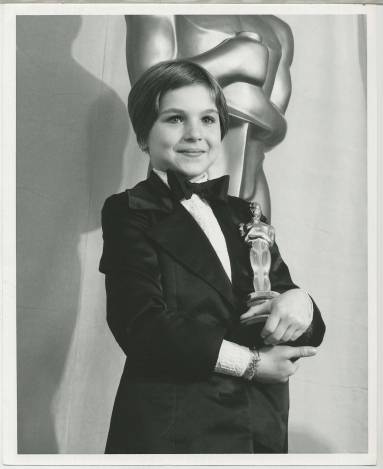
Tatum O'Neal (supporting) - 1973 (46th)Tatum O’Neal, 1974: The 46th Academy Awards took place at the Dorothy Chandler Pavilion on April 2, 1974, and was hosted by John Huston, Diana Ross, Burt Reynolds, and David Niven. Not only did three-time winner Katharine Hepburn make her very first appearance at the ceremony, but a first-timer, Tatum O’Neal, became the youngest Oscar winner in history that evening. Ten-year-old O’Neal earned a supporting actress trophy for playing opposite her father, Ryan, in Paper Moon. Her costar Madeline Kahn was nominated in the same category, along with another young star Linda Blair (The Exorcist), Candy Clark (American Graffiti), and Sylvia Sidney (Summer Wishes, Winter Dreams). Jack Lemmon earned a lead actor Oscar for Save the Tiger, and Glenda Jackson was best actress for A Touch of Class. The picture and director trophies went to George Roy Hill’s The Sting. It was also the year of the infamous streaker…

“All I really want to thank is my director Peter Bogdanovich and my father. Thank you.”—Tatum O’Neal, whose grandfather accompanied her to the stage, accepting her first Oscar for her supporting role in Paper Moon.

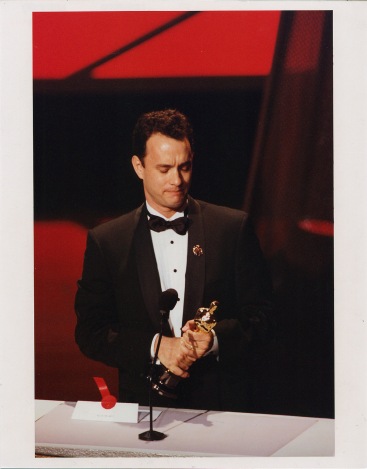
Tom Hanks (actor) - 1993 (66th)Tom Hanks, 1994: The 66th Academy Awards took place March 21, 1994, at the Dorothy Chandler Pavilion and was hosted by Whoopi Goldberg, the first African-American to host an Oscar telecast alone. All four of the year’s acting trophies went to first-timers, too. Holly Hunter and Anna Paquin earned lead and supporting actress honors for The Piano, while Tommy Lee Jones won supporting actor for The Fugitive. But the most moving speech of the night came from Tom Hanks, who won best actor for playing a man with AIDS in Philadelphia. Not only did he pay touching tribute to his wife and costars in the speech, he thanked a teacher and classmate who inspired him in the role. Steven Spielberg won his first directing trophy for Schindler’s List, which also gave him a second Oscar that night when it also took home best picture.

“I would not be standing here if it weren’t for two very important men in my life: Mr. Rawley Farnsworth—who was my high-school drama teacher, who taught me to act well the part, there all the glory lies—and one of my classmates under Mr. Farnsworth, Mr. John Gilkerson. I mention their names because they are two of the finest gay Americans, two wonderful men that I had the good fortune to be associated with, to fall under their inspiration at such a young age. I wish my babies could have the same sort of teacher, the same sort of friends.

“And there lies my dilemma here tonight. I know that my work in this case is magnified by the fact that the streets of heaven are too crowded with angels. We know their names. They number a thousand for each one of the red ribbons that we wear here tonight. They finally rest in the warm embrace of the gracious creator of us all—a healing embrace that cools their fevers, that clears their skin, and allows their eyes to see the simple, self-evident, common-sense truth that is made manifest by the benevolent creator of us all and was written down on paper by wise men, tolerant men, in the city of Philadelphia 200 years ago. God bless you all. God have mercy on us all. And God bless America.”—Tom Hanks accepting his first best actor Oscar for Philadelphia. He won his second Oscar the following year for Forrest Gump.

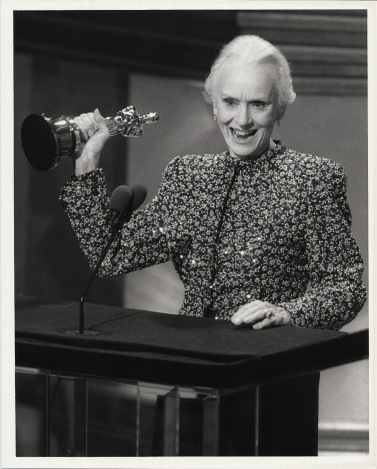
Jessica Tandy (actress) - 1989 (62nd)Jessica Tandy, 1999: First-time Oscar emcee Billy Crystal hosted the 62nd Academy Awards, which took place March 26, 1990, at the Dorothy Chandler Pavilion. And when the independent feature Driving Miss Daisy took home best picture without a directing nomination for Bruce Beresford, the Oscar-prognosticating rulebooks were forever altered. The film won a total of four trophies that night, including best actress for Jessica Tandy. Daniel Day-Lewis took home best actor for My Left Foot, and directing honors went to Oliver Stone for Born on the Fourth of July. Supporting honors went to Brenda Fricker for My Left Foot and Denzel Washington for Glory.

“I never expected in a million years that I would ever be in this position. It’s a miracle. And I thank my lucky stars and Richard and Lili Zanuck, who had the faith to give me this wonderful chance. And also, most especially, to that forgotten man, my director Bruce Beresford. The cast that was with me, which made a wonderful, happy family. It was a pleasure to go to work with them all each day. And to Sam Cohn, who takes such good care of me. Thank you, the Academy, and all of you. I am on cloud nine!”—Jessica Tandy in accepting her first and only best actress Oscar for Driving Miss Daisy.

Nominated Documentaries Traverse Challenging Territory

Ari Karpel and David Mermelstein are AwardsLine contributors

From the homemade, unpolished qualities of 5 Broken Cameras and The Gatekeepers to the journalism of How To Survive A Plague and the investigations of The Invisible War and Searching For Sugar Man, this year’s documentary feature nominees traverse challenging and rewarding territory. Here’s a look at the films from which voters must choose.

5 Broken Cameras5 Broken Cameras

The homemade quality that permeates 5 Broken Cameras is its greatest strength. For what this plainspoken documentary lacks in polish, it makes up for in heartfelt emotion. The film centers on the life of its filmmaker, Emad Burnat, a Palestinian resident of Bil’in, a village in the occupied West Bank near the Israeli border. It opens with the birth of Burnat’s son Gibreel in 2005. Then, paralleling the first few years of Gibreel’s life, the film charts the hardships endured by the village as it copes with the erection of a barrier, built by Israel, that separates Bil’in from its olives groves.

“I just started to film and document my people’s nonviolent struggles in the village in 2005,” Burnat says, speaking recently by phone from Bil’in. “I decided to take part with my camera. I used it for many purposes. I was the only one in my village with a camera. I used it to protect myself and to spread the news to TV. I wanted to make this not like any other documentary. I was filming for more than five years, and then I decided to start the editing.”

Soon the nonviolent protests in Bil’in attracted sympathetic outsiders, including Israeli peace activists, one of whom, Guy Davidi, was also a filmmaker. Over time, Burnat and Davidi got to know and trust each other, resulting in a collaboration that produced this film.

“Of course, I wanted to say something political,” Davidi explains, speaking by phone from Tel Aviv. “But my real message was an emotional journey. In order to change opinions, you have to go through an emotional experience. You may do it through art. If you’re open emotionally to experiences, then you’re shocked and change your ideas. I’m looking to build motivation for change. There are a lot of ideas in the film. And you see how the Israeli side is reacting in a violent, aggressive way to this movement. You see how the government is treating a modest, friendly movement. And yet those Palestinians who are protesting are criticized by other elements in Palestinian society. Both of us, Emad and me, took big risks to do this film.”

Explaining his motivations not just to make this film, but also to do so by working with an Israeli, Burnat says: “People are suffering. Children are growing up here in a very bad situation, not a normal situation. We are the only people in the world who live under an occupation. I want my children to grow up in my home as others do in the world. I want them to have freedom and justice.”

Burnat’s big ambitions for this film might have seemed unrealistic before its Oscar nomination, but now this documentary’s reach has clearly widened. “I hope for this movie to go out and reach every house in the world,” Burnat says. “People can get to know more about our lives and about reality and truth. This is my personal story. I was suffering with my family. I made it very real. This is our life here. I didn’t want to make it like other documentaries, talking about violence and politics. I want people to see the reality. And they will be touched by seeing this story and feel very close to it. We are all human. I wanted to make it so everybody in the world can think together and make change together.”

—David Mermelstein
GatekeepersThe Gatekeepers

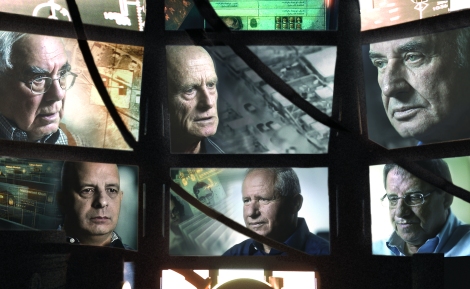
Dror Moreh’s documentary The Gatekeepers isn’t fancy. But it is sobering. In fact, the director’s unsentimental examination of Israel’s ongoing Palestinian problem gains force because of its simplicity—it’s essentially six talking heads (all the living former heads of Shin Bet, Israel’s internal security service) and some elegant reenactments.

Those six men live up to their billing as stoic sentinels of Israel’s precarious security, and Moreh’s achievement is to get them to speak straightforwardly, if sometimes cautiously, about Israel’s untenable occupation of Palestinian territory.

“I wanted to make a movie from the most prominent people who were dealing with the conflict,” Moreh says. “If there’s someone who understands this situation, it’s them. They dealt with the terrorists. If there’s someone who knows about this situation, it’s them.”

The hard part, obviously, was getting security chiefs who made their careers in the covert world to open up in front of the camera. But Moreh had a strategy. “When you are trying to get to these people, it’s not like they have a club where they all sit around drinking whiskey and smoking cigars,” he says. “But I knew that getting one was the key—because if the first one says no, you’ve failed. If the first one says yes, you have a chance.”

That approach worked, though it wasn’t always easy. His toughest “get” was Avraham Shalom—Moreh calls him “the old man”—who ran Shin Bet from 1981 to 1986 and was forced to resign over allegations that he ordered the summary execution of two terrorists following a bus hijacking in April 1984. “He never spoke before—especially after the bus incident, where he gave the order to kill those guys,” Moreh says. “The first interview I did with him—and he said yes only after three meetings—it was like banging my head against the wall. He answered only ‘yes,’ ‘no,’ ‘OK,’ like that. In the second interview, he was more open. Before the third interview, I told him he had to speak about the bus incident. He said, ‘I will see.’ And in the movie, you see me prod him. It was the toughest interview of my life. I was sweating like you wouldn’t believe. When he’s angry, that’s very hard. And you see his look in the movie. It’s really not easy. The confrontation between us is much more fierce than you see in the movie. But after the movie came out, he told me it should have been more harsh on the politicians.”

Moreh says his documentary will resonate with American audiences for various reasons, most obviously because of the historically close ties between the U.S. and Israel. But there are other, more recent, points of tangency, he maintains. “I think there is something parallel in America—the questions of torture and drone assassination,” he says. “Issues raised in my film are relevant to public debate in America—whether such things are morally acceptable. Where are the boundaries? And does it lead to a better future? The strategic question in The Gatekeepers is: What can we do to prevent the next attack? Israel has dealt with this for a long time, and now America is dealing with it. So The Gatekeepers is very relevant to the American people.”

—David Mermelstein
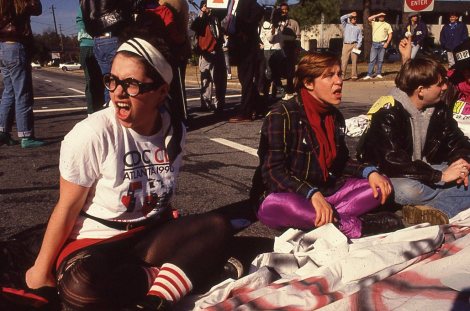
How to Survive a PlagueHow To Survive A Plague

David France became a journalist because of the AIDS crisis. “I thought maybe I could find answers,” he recalls of the early, desperate days of the epidemic, when he cut his teeth as a science reporter for the weekly gay newspaper The New York Native, in 1982. France was a witness to the dawn of AIDS activism at a time filled with rage and fear, when members of ACT UP (the AIDS Coalition to Unleash Power) and its spinoff TAG (the Treatment Action Group) rattled the cages of the political and medical establishments. “There had been this hard-and-fast rule that you don’t discuss anything about your findings until after peer-review publication,” says France.

Thirty years later, his film How To Survive A Plague, nominated for an Independent Spirit Award and an Academy Award, revisits the small group of people who succeeded in getting drugs approved more quickly—work that helped to transform AIDS from a death sentence into a livable condition. “It’s an unknown story, really.”

Unknown, that is, beyond those present at the time. But even they rarely discuss it. “No one really spoke of it after ’96,” says France, who continued writing about science and went on to become an editor at New York magazine. All the while he held onto the notion that someday he would make a “big project” that would give context to those years. He started off with some magazine articles. “I was surprised by how little people knew about (what had happened),” he says of young readers, gay and straight, whom he heard from across the country. “They were shocked by the herculean effort, the grassroots mobilizing it took to get the system to respond; that gays and lesbians were so disenfranchised; that we weren’t always just talking about marriage.” Those ideas can be empowering to a younger generation, to learn that just a short time ago a group of people were fighting, France says, to be treated as human beings.

His mission articulated, France began gathering video. He remembered that there would be as many as five video cameras present at every ACT UP meeting and demonstration. When he got ahold of one tape, he’d scan it for passing shots of other people with video cameras and track those people down. “That’s how I found more footage.” In fact, he says, “That’s how I got coverage.”

The term “found footage” doesn’t quite do justice to the wealth of video France amassed. “People were using their footage to create important pieces along the way, whether they were art pieces, gay TV journalism for public access cable,” he explains. “Some of it was shot to be brought back to meetings to show what (subgroups) had accomplished.” Often cameras were present as a check on police brutality.

The footage allowed France to craft the film entirely without narration and with relatively few talking heads. Watching How to Survive a Plague feels much like watching the issues unfold in real life, as if you were there.

“There was no way to tell the story without acknowledging the camera,” France says. “The camera itself was a main character in the history.”

—Ari Karpel
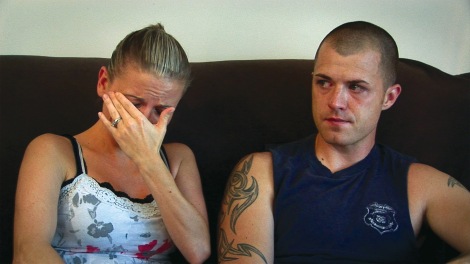
Invisible WarThe Invisible War

Kirby Dick is a master muckraker. His first Academy Award nomination was for his 2004 documentary Twist of Faith, which exposed the hypocrisy of the Catholic Church in the face of increasing accusations of child sexual abuse by priests. Dick’s next doc, This Film Is Not Yet Rated, took on a less far-reaching but perhaps no less mysterious monolith of an organization, the Motion Picture Association of America, and its highly secretive ratings board. He then had a crack at Republican politicians who vote against gay rights but who, according to Dick’s 2009 film Outrage, are themselves secretly gay.

Now, with The Invisible War, Dick and Amy Ziering have turned their lens on the U.S. armed forces and the scores of women and men who have been sexually assaulted by officers or fellow service members, and whose lives have been destroyed by the systematic negation of their accusations. The film has earned Dick his second Academy nomination, but more importantly, it is having significant impact on the policies and culture of the Army, Navy, Air Force, and Marines.

Last April, before the film was released in theaters, Secretary of Defense Leon Panetta viewed it and promptly executed a shift in policy. He took away commanders’ power to decide whether to prosecute their service members for rape. It’s a massive accomplishment, and yet it doesn’t go anywhere near resolving the issue, a limitation Dick forthrightly acknowledges. “One year of changes is not going to address the problem,” he says. “Panetta did not take it out of the chain of command, so there is still a conflict of interest.” Dick says that putting the issue in the hands of investigators and prosecutors who are trained to handle these things would be the “single most important thing they could do.”

In the meantime, the film has placed increasing pressure on Congress and the Department of Defense to address a problem that is truly staggering in its scope—it’s estimated that half a million women have been sexually assaulted in the military. The film has become the reference point for this issue in the military and Congress. “We’ve had four-star generals tell us that this film told them more than all their briefings in 40 years of service,” says Dick. “Chiefs of staff are using lines right out of the film.”

Dick says that Ziering was instrumental in convincing nearly 50 abused women, and one man, to tell their stories on camera. The result is a shocking collection of accounts. “These interviews were emotionally devastating for us, and equally enraging,” he says. “What the audience feels is what we felt.”

The emotional effect has not been lost on those with the power to change things. “I thought they were going to try to discredit the survivors,” says Dick, who knows from experience that large institutions typically respond to criticism with a closing of ranks. “They tend to react with a powerful P.R. counterattack, but they didn’t because the film made such a powerful case that it’s across the force, in all branches. The people at the top really do care about their soldiers, airmen, and marines.”

He can’t help but conclude: “It moved them.”

—Ari Karpel
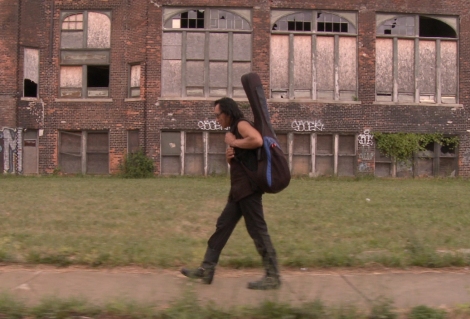
Searching for Sugar ManSearching For Sugar Man

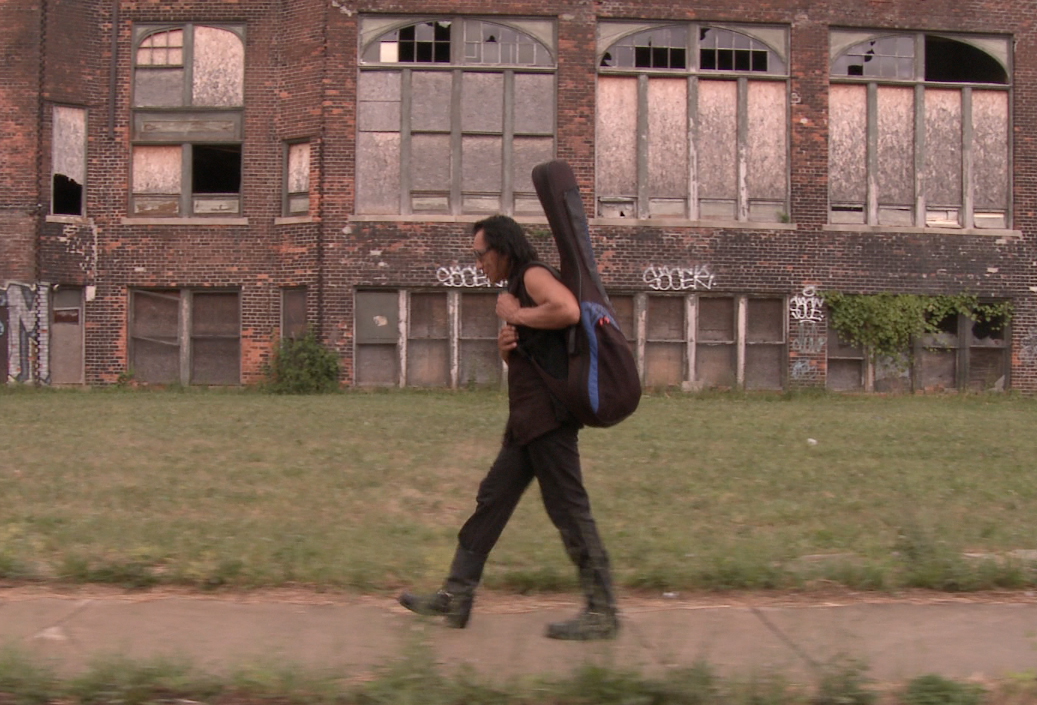
In 2006, Malik Bendjelloul quit his job as a reporter for a weekly arts and culture television show in Sweden to embark on a six-month-long backpacking trek around the world, camera in tow, in search of new stories. He came upon a goldmine of a tale in South Africa.

Back in the early 1970s, when South Africa was under apartheid rule, there was one singer-songwriter whose folk-rock protest music captivated and inspired a white, liberal audience yearning for a new way to live. Rodriguez was the singer’s name. He was an American whose career had failed in the States. But in South Africa, his 1970 album, Cold Fact, was bigger than the Beatles’ Abbey Road.

Still, no one knew anything about Rodriguez. Rumors swirled that he had killed himself on stage. By some accounts he had set himself on fire; others said he shot himself in the head. Either way, it was a gruesome tragedy and it drove Steven Segerman, a Capetown record-store owner known as “Sugar Man,” for one of Rodriguez’s best-known songs, to spend a decade searching for the true story of Rodriguez.

He found more than he’d bargained for. It turned out Rodriguez was alive and well and living in a ramshackle old house in Detroit, oblivious to the legendary renown he had achieved halfway around the world. And he had never seen a cent of the royalties for his South African success.

This is the story that Bendjelloul recounts in Searching For Sugar Man, his documentary that won the Audience Award and a Special Jury Prize at Sundance, the PGA Award, and has BAFTA and Oscar noms for best documentary feature. Bendjelloul tells it pretty much as he learned it, from beginning to end, from rumor to fact, from mystery to revelation. “It’s just beautiful,” he says. “It’s like a Cinderella story, a true Cinderella story, about a man who lives life as a construction worker in Detroit and doesn’t know he’s bigger than the Rolling Stones halfway around the world.”

As the film details, Sugar Man eventually tracked down Rodriguez via the Internet. He told the musician of his success and brought him to South Africa to perform for his ecstatic fans. Since the film came out, Rodriguez’s career has been fully resuscitated. He has appeared on Leno and Letterman, and he’s about to begin a tour of South Africa, one Bendjelloul hopes doesn’t keep the singer from attending the Oscars.

“I was aiming for people to engage on an emotional level, not just cerebrally feel for him,” says Bendjelloul. The emotion of the fans, and of Rodriguez, is palpable in the film. Rodriguez is living the life he’s long been meant to lead, that of a musician singing his truth. “His life is changing,” Bendjelloul says of the 70-year-old musician, “but only in an abstract way. He’s always going to live in that house.”

Bendjelloul finds inspiration in that for his own work. Having made Searching For Sugar Man on a shoestring, he intends to continue that way of working. “I think the key is to try to keep it small enough to be in control, to do what you want to do. Not having people tell you what to do.”

To that end, Bendjelloul says, “I may go travel for six months again.” After all, the world is full of extraordinary stories.

—Ari Karpel

Moments In Oscar History, Part 1: The Producers

In honor of the 85th Academy Awards, AwardsLine is spotlighting memorable moments and winners from the last eight decades. This is Part 1: The Producers. Part 2 will be Actors & Actresses; Part 3 will be The Directors.

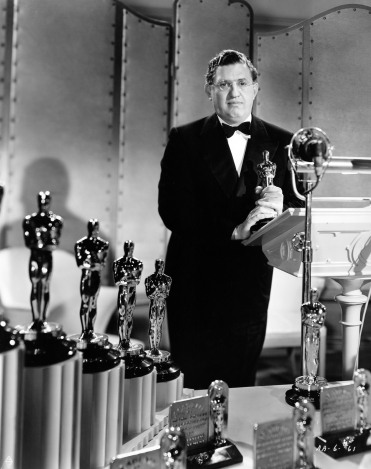
David O. SelznickDavid O. Selznick, 1940: The 12th Academy Awards took place at the Ambassador Hotel on Feb. 29, 1940, honoring a year that produced some of the most enduring films in history. Not only did David O. Selznick’s Gone With the Wind earn a recordbreaking eight statuettes—including picture, director for Victor Fleming, and actress for Vivien Leigh—but other well-known classics enjoyed nominations, including Dark Victory, Mr. Smith Goes to Washington, Ninotchka, and The Wizard of Oz. Frank Capra was both a nominee and director of the show, having sold the rights to a documentary of the proceedings to Warner Bros. Bob Hope hosted for the first time, although the Los Angeles Times eliminated some of the suspense by printing the winners in its evening edition, which attendees could read on the way to the ceremony. Robert Donat earned a best actor award for Goodbye, Mr. Chips.

“Paramount executive Y. Frank Freeman was called upon to bestow the best picture award. Since there was no longer any question as to what was going to win, Freeman kidded, ‘The only reason I was called upon to give this honor is because I have a Southern accent.’ Handing Selznick the award, Freeman drawled, ‘I present this trophy to you, David Selznick. But David, I never saw so many soldiers as were used in Gone With the Wind. Believe me, if the Confederate Army had that many, we would have licked you damn Yankees.’”

–Excerpt from Inside Oscar (Damien Bona, Ballantine Books, 1996) detailing David O. Selznick’s best picture Oscar acceptance for Gone With the Wind, which went through two directors—George Cukor and Sam Wood—prior to Victor Fleming.

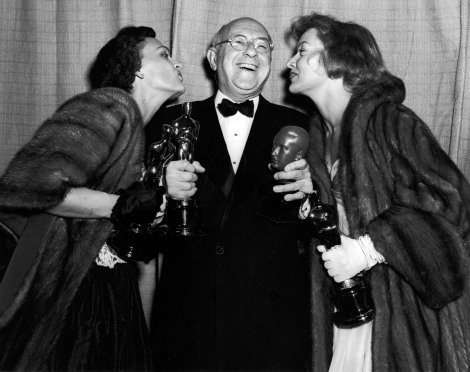
Cecil B. DemilleCecil B. DeMille, 1953: The 25th Academy Awards ceremony took place March 19, 1953, at the Pantages Theater. It was hosted by Bob Hope—his sixth time as emcee—and the ceremony aired on television for the very first time, despite the movie industry’s reticence to embrace the new medium. Although commercial TV had only been around for about five years, the Oscar telecast drew the largest audience to date. Gary Cooper won best actor for High Noon; Shirley Booth was best actress for Come Back, Little Sheba; and best director was John Ford for The Quiet Man.

“On behalf of the thousands that it took to make The Greatest Show on Earth, I thank you for them. For the stars and the electricians, for the circus people, for their bravery. I thank you for all of them because I am only one little link in a chain that produced that picture. And I’m very happy for them. Thank you.”

Cecil B. DeMille (with Katherine DeMille Quinn, left, and Gloria Grahame) accepting the 1952 best picture Oscar for The Greatest Show on Earth. He earned the Irving G. Thalberg Memorial Award that same year. His only other statuette was an honorary Oscar in 1950.

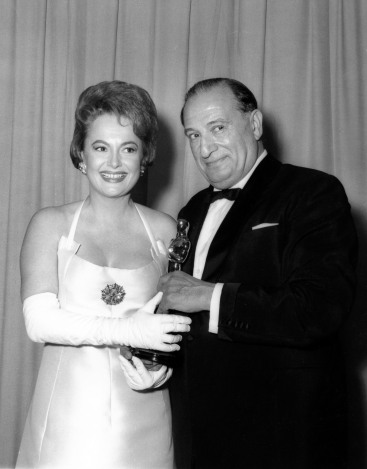
Sam SpiegelSam Spiegel, 1963: The 35th Academy Awards took place April 8, 1963, at the Santa Monica Civic Auditorium, and Frank Sinatra had hosting duties for the first time. Lawrence of Arabia was the big winner of the night, taking home seven statuettes, including picture and director for David Lean. Best actor was Gregory Peck for To Kill a Mockingbird and best actress was Anne Bancroft for The Miracle Worker.

“Ladies and gentlemen, there is no magic formula for creating good pictures. They are made with the serious, concerted hard work by everyone connected in the making of them: The writer, the director, the technicians, the actors, thousands of employees off the picture during the making of it. In behalf of all of those who sweated months in the desert to create this picture, I deeply, sincerely thank the voters of the Academy and proudly accept this honor, proudly and humbly. Thank you.”

Sam Spiegel (with Olivia de Havilland) accepting the 1962 best picture Oscar for Lawrence of Arabia. He won two other Oscars, for 1954’s On the Waterfront and 1957’s Bridge on the River Kwai, plus earned the Irving G. Thalberg Memorial Award in 1964.

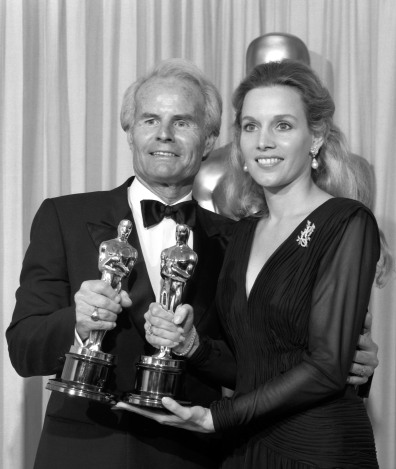
Richard and Lili ZanuckRichard D. & Lili Fini Zanuck, 1990: The 62nd Academy Awards took place March 26, 1990, at the Dorothy Chandler Pavilion, with Billy Crystal taking his maiden voyage as host. Longtime telecast producer Gil Cates held the reins behind the scenes for the first time, as well. The low-budget favorite Driving Miss Daisy earned a total of four Oscars, including best actress for Jessica Tandy and best picture. Daniel Day-Lewis took home best actor for My Left Foot, and directing honors went to Oliver Stone for Born on the Fourth of July.

“Thank you, Academy. We’re up here for really one very simple reason, and that’s the fact that Bruce Beresford is a brilliant director. It’s as simple as that.”[Ed. note: Beresford did not receive a directing nom that year].

—Richard D. Zanuck accepting the 1989 best picture Oscar for Driving Miss Daisy. He earned one more Oscar in 1991, the Irving G. Thalberg Memorial Award.

“I hope I’m as religious all the rest of the year as I’ve been the last two months. I would very much like to thank the Academy for honoring us and making my mama so proud. Thank you.”

—Lili Fini Zanuck accepting for Driving Miss Daisy.

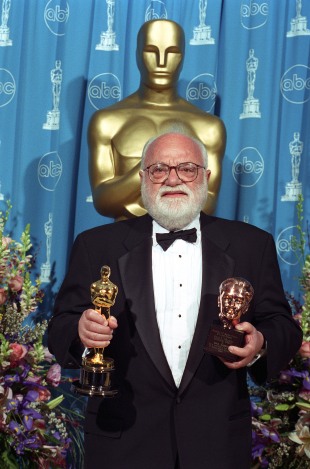
Saul Zaentz Saul Zaentz, 1997: The 69th Academy Awards took place March 24, 1997, at the Shrine Auditorium. Billy Crystal, by now a familiar face at the telecast, hosted for the fifth time. But the ceremony did have a first: No major studio took home any Oscars in the major categories. The picture and director prizes went to The English Patient; best actor was Geoffrey Rush for Shine; and best actress went to Frances McDormand for Fargo. All were independently produced features.

“I said my cup was full before, now it runneth over. I’d like to thank actors. I love actors. Producers are supposed to not be in love with them, but I love ’em. And I love writers and directors, too. And everyone who worked on the picture, for what they did in making the picture happen. When we were shut down, ran out of money, everyone stayed there in Italy, without pay. Then Harvey and Bob Weinstein came through and financed the picture—we had final cut, though.”

—Saul Zaentz accepting the 1996 best picture Oscar for The English Patient. At the same ceremony, he also earned the Irving G. Thalberg Memorial Award. English Patient marked his third best picture win following 1975’s One Flew Over the Cuckoo’s Nest and 1984’s Amadeus.

Q&A: Harvey Weinstein On His Contenders

Mike Fleming Jr. is Deadline’s film editor. This article appeared in the Feb. 6 issue of AwardsLine.

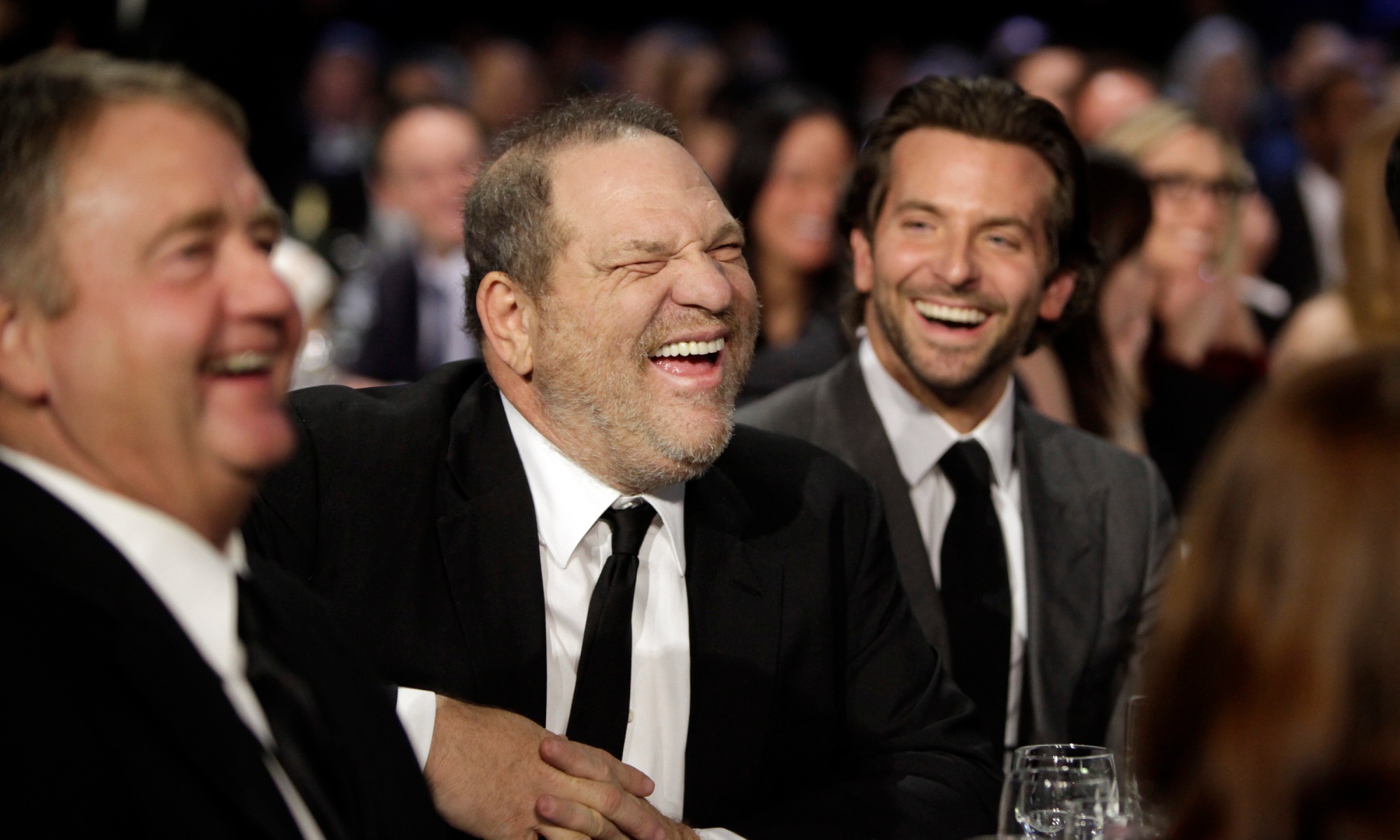
When Harvey Weinstein sat down at Sundance for what has become an annual interview with Deadline, he looked as tired as I felt. He, David Glasser, and the rest of the team stayed awake all night to make a splashy deal for Fruitvale, one of the best-liked titles at Sundance. A fixture at this festival since he helped turn it into a lucrative market back in 1989 when he bought and found crossover success with Steven Soderbergh’s sex, lies & videotape, Weinstein is several years removed from reports of money problems and a studio that had to refocus because he was preoccupied with other businesses. The reigning two-time best picture Oscar champ has two films in this year’s wide-open race; and he’s making a fortune on a film he’s not releasing, The Hobbit, because of gross points he took to allow Peter Jackson shop The Lord of the Rings. He discusses politics, Sundance, and of course the Oscars, though remains circumspect on the latter, fully aware that the voting period is in full swing.

AWARDSLINE: And here I’d read in The Hollywood Reporter that you’d be at Barack Obama’s inauguration today. On behalf of Deadline, thanks for cancelling. He’s the leader of the free world, so this can’t be about me. Is Nikki Finke that powerful?

HARVEY WEINSTEIN: (Long pause). I’ll say yes. (Laughs.) The thing I love about Nikki Finke is, I’ve got Silver Linings Playbook in its 12th week, grossing $13+ million. Unheard of for a movie to complete the platform it had and go wide like this, and it kills it, the No. 3 movie in the country, beating all the new releases. Does she write, “Outstanding!” “Boy they were smart!” “God, they’re going to do $100 million,” or “Shit, I was wrong”? Nothing. The movie’s at $58 million now, and we’re six weeks until the Oscars. Silver Linings is going to gross $100 million. And when it does, I suppose she’ll just say, “Silver Linings grossed $100 million.”

AWARDSLINE: You’ve had the best picture winner two years running. This year, two of the nine nominated pictures are yours. Make a case why Silver Linings Playbook and Django Unchained would each make a worthy winner. 

WEINSTEIN: I don’t want to do that. Anyone who talks about this Oscar race has to deal with the fact that this was such a good year for movies that, who knows? Life of Pi, brilliant—Ang Lee at his absolute best. Lincoln’s a masterpiece. Ben Affleck hit it out of the ballpark with Argo. Zero Dark Thirty. Amour, amazing, and those guys did such a good job getting that film noticed and nominated. Beasts of the Southern Wild, Les Misérables. Stupendous year.
AWARDSLINE: Let’s attack it another way. You worked on Silver Linings Playbook for years, and it started as a Sydney Pollack project. He couldn’t crack the idea of a comedy with a bipolar protagonist. He brought in David O. Russell, who made it work. What was the creative breakthrough?

WEINSTEIN: Here was the eureka moment: People who are bipolar or depressed or are borderline don’t usually say, “Hey, that’s me.” The same way stutterers felt before The King’s Speech. They hid it in shame. The movie destigmatized that, same as The King’s Speech did. David O. Russell’s son, as he’s admitted, is borderline. And he one day said to him—and this was the key that unlocked the movie—“I don’t want to live in this world.” To hear that as a father, you can just imagine how he felt. And he wrote this to give hope to people who have this problem. Everyone in this movie has something. Bradley Cooper’s character is bipolar, Jennifer Lawrence’s character has problems, and Bob De Niro’s character is obsessive compulsive. It is no day in the park, but David used humor beautifully to deal with an important subject, in a way that gives people hope. Sydney going to David was serendipitous for all of us. This is the last project for Sydney and Anthony Minghella, the final project for two exceptional men who influenced our industry in an incredible way. This was Sydney’s more than Anthony’s; it’s really Sydney’s last hurrah and that means a lot to us. And of course, Django means a lot to us because it’s Quentin.
AWARDSLINE: People seem to tiptoe around controversy during Oscar voting. Anybody who read Quentin’s Django Unchained when it circulated two years ago could see what was coming, from the violence to the degradation of slaves, to the used of the N-word, to the spaghetti-western style and humor. When media reports count the number of times the “N” word was used and play that as big news, how much harder does that make it for you during this voting period?

WEINSTEIN: The movie has had champions from Jesse Jackson to Al Sharpton to BET to the NAACP; it got five Oscar nominations including best picture. The people who are for it are much more influential than the people who are against it, and they’ve put out a lot of those early fires started in some cases by people who hadn’t even seen the film, which is irresponsible. The “N” word was in Lincoln, too, because that’s what they were called. It was in Roots. They weren’t called African-Americans then; the reference was way more derogatory.

AWARDSLINE: Was Quentin robbed of a nomination for director?

WEINSTEIN: I don’t want to use the word “robbed,” but Quentin Tarantino not in the running for best director? He is one of the greatest directors of our time. Here’s what I think happened on Django. We finished the movie Dec. 1. We didn’t show it until a few days later. The race was early this year: The voting cutoff was Jan. 3. We tried to show it to people in theaters, not on DVD. It’s an epic movie and that man put his whole life and heart into this. It’s his most important movie, his most important subject matter, and the idea of DVDs stopped me cold.

AWARDSLINE: What do you mean? Even I have an Oscar DVD.

WEINSTEIN: I delayed them. I wanted people to see it on the big screen. I told Quentin we’d probably pay the price at the Oscars, but it was the right way to see an epic period movie about a man who does not give up. Eventually, we gave out the DVDs, but we paid the price for being late. We paid no price as far as the gigantic business the movie’s doing. It’s the biggest of Quentin’s career. After we put our heart and soul into the movie, the Oscar campaign was secondary. But make no mistake about it—we got five nominations including best picture, and we only had one week. We sent the DVDs out on Dec. 17.

AWARDSLINE: The first script had an even harsher depiction of how slave women and Broomhilda in particular were used for sex by their masters, and how male slaves were used in gruesome fights to the death to entertain those masters. Did you ever say, “Quentin, I don’t know”? After all, you have been in business with him his whole career, and you’re the one who markets these movies.

WEINSTEIN: Quentin is so educated on the subject that the original idea for this wasn’t even a movie. Ten years ago, he spoke to me about how Birth of a Nation had been lauded and yet there was this strand of racism in it that had been ignored by major critics who’d put it at or near the top of their all-time best lists. I watched Birth of a Nation and suggested that he do a piece for The New Yorker, a 30- or 40-page treatise. You know Quentin, he can write like any film professor. He writes brilliant scripts, and trust me, I read pages of the treatise. It was astounding. And the amount of research he put into the slave era is astonishing. If anything, I’m the one who said to him, “If you really want to show slavery, show it.” It was worse than what we put on that screen. Way, way worse. All I said was, “We’ve got to find a way to get an audience inspired by this, to do their own research, but not turn them off at the same time.” I knew Quentin knows this subject better than anybody, and when you’ve got someone like that who wants to bring that incredible knowledge to the screen, you just let them be.

AWARDSLINE: What about Paul Thomas Anderson’s The Master? Why didn’t it click with a wider audience?

WEINSTEIN: I probably could have marketed it better. I probably should have prepared the audience. We opened up to the highest arts per screen ever, and I just think the audience had trouble with the movie. They needed to be guided. I was so enamored with the film that I didn’t think the audience would have that trouble. Other people around me did say the audience was going to have that trouble but I personally loved the movie and Paul. Maybe I would have done him more of a favor being a better devil’s advocate, instead of a cheerleader. That is what I always think a distributor should be, a cheerleader and not a devil’s advocate. I seem to do better when I’m devil’s advocate. I do think the film will live stand up and have a long life down the line.

AWARDSLINE: Everybody says you do this Oscar campaigning the best.

WEINSTEIN: It’s always about the movies. I don’t know what people think we’re campaigning. Where? Have you seen me campaigning?

AWARDSLINE: No. Well, for Obama.

WEINSTEIN: That’s about the only campaigning I’ve done this year and last.

AWARDSLINE: What prompted this political activism?

WEINSTEIN: I was cursed with it when I went to college. I had two Irish roommates, Dennis Ward and Eugene Fahey. Eugene is now a New York State Supreme Court Judge, one of the highest in the state; Dennis is a constitutional lawyer. Instead of going out and having a good time like I should have in those college years, I went with these guys as they ran the campaign for the mayor or the councilman and I’d be out there hanging posters and handing out stickers. Politics has been part of me since I was 17, when I met those guys. They still call me every five minutes. There’s always another issue, another problem. We should have been in more bars having fun, and instead we were in town hall meetings.

AWARDSLINE: How has your flair for marketing and organization helped in being an ally for the president or other politicians? What has been most gratifying?

WEINSTEIN: The concert for Hurricane Sandy was more gratifying than anything I’ve done in movies. We raised over $60 million in one night. Jim Dolan, John Sykes and I produced that show. This started the same way as the 9/11 concert. I was in Los Angeles, watching Hurricane Sandy on television. My grandma used to have a little cottage in Rockaway. We didn’t go to the French countryside back then, you know? The Weinstein family was packed into this Rockaway bungalow. I’m watching the TV and there is no Rockaway. The boardwalk was floating in the water. I called Jim Dolan and said, “We gotta go do something.” So where was I campaigning for movies? I was producing that concert around the clock, 24/7, right after the election.

Foreign Language Nominees Tell Intimate, Personal Stories

David Mermelstein is an AwardsLine contributor. This article appeared in the Feb. 6 issue of AwardsLine.

If one thing links all five of this year’s nominees for the foreign film Oscar, it’s that the director of each picture was driven to make his movie because of strong, deeply personal feelings. These five films—a varied batch if ever there was one—have nothing in common in terms of where and when they are set, but they all deal, unapologetically, with powerful emotions. And those feelings are expressed not only by the characters in these films, but also by their creators.

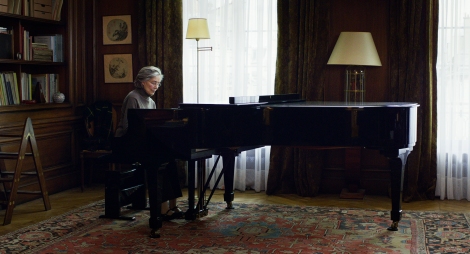
The French-language Amour follows a husband who must care for his ailing wife.

Perhaps the most obviously personal is Michael Haneke’s Amour, which achieved the rare feat of earning best picture and director noms, as well. The film has been cited for, among other things, its unblinking look at the degradations inflicted by illness on an aged couple. The German-born writer-director says that his recollections of a beloved aunt’s increasing infirmity inspired him to make the film. “I was forced to look on as someone very close to me suffered, someone for whom I cared very much,” he says, noting that the specifics of his aunt’s condition were not replicated in the movie. “What’s shown in the film is the product of lengthy research and my imagination.”

Yet one especially chilling aspect of his aunt’s situation—her asking him to assist in her suicide—was strongly echoed in the film. “Of course I had to tell her I was unable to do it,” Haneke recalls, “because I would have been put in jail if I had done it. I was grateful for that alibi, for I don’t know if I would have had the strength to do it otherwise. But she did it anyway, without my help.”

Asked whether he himself—now age 70—worries about a fate similar to that faced by the principal characters in Amour (portrayed with uncanny and moving effect by octogenarians Jean-Louis Trintignant and Emmanuelle Riva, who earned a best actress nomination for the role), Haneke responds wryly and invokes another, very different, master filmmaker. “Billy Wilder was asked a similar question,” Haneke says, “and he responded by saying that the bombardments, so to speak, are coming ever closer.”

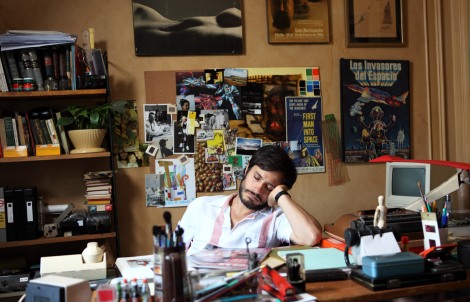
Gael Garcia Bernal stars in No, which takes place in Chile, following the removal of dictator Augosto Pinochet.

Chilean director Pablo Larrain’s closeness to the subject of his film No is palpable, even though he was only 12 years old when the1988 referendum that removed strongman Augusto Pinochet as president of Chile occurred. His film examines that historic vote from an unconventional perspective—through the eyes of a young marketing executive, played by Gael Garcia Bernal—but the view is no less compelling for its novelty.

“It’s a big shadow for everyone in my country,” Larrain says, referring to Pinochet’s 17-year dictatorship. “We are still quite divided. You cannot avoid it or pretend it never happened. Pinochet died at the end of 2006, not long ago—a free man and rich. He’s a very controversial figure. He really damaged our society and created a lot of pain. You can’t pretend it doesn’t affect you.”

Though Larrain didn’t encounter outright opposition to his unconventional dissection of a delicate subject, his approach did elicit some head scratching in his country. “There were people who were curious why we picked the ad guy’s perspective,” the director acknowledges. “When you do a movie like this, a period movie but not from long ago—and it’s a huge date in my country—everyone has an opinion about it. So we had to deal with walking on eggshells.”

Politics weren’t the issue. “Now most people—nearly 90 percent—would say no to Pinochet, or to another one like him,” insists Larrain, whose choice of protagonist proved more controversial. “Some people felt we were telling this story to the world through the eyes of people who weren’t the most important, but I think the ad guys were important on many levels. Pinochet imposed capitalism on Chile and brought with it the logic of marketing and advertising. So without realizing it, he created the tools that finally pulled him out. And we thought that was fantastic. There were other people who were important in the No campaign, but I’m not sure they would have succeeded without these ad guys, because they made people feel more comfortable about voting no.”

Larrain offers an unexpected analogy to explain his film’s foundation. “It’s like ancient Greek tragedy,” he says, noting how Pinochet was, in effect, undone by instruments of his own making. “The more you try to avoid your death, the closer you get to it. What happened with Pinochet is a little Greek story, in my opinion. If they had known, they would have reacted differently. But by the time they knew, it was already too late. It’s a paradox, and we know that works very well in movies.”

Though the director at first maintains that his movie “doesn’t intend to be a political film,” he then allows, “I would understand if somebody thinks so.” Ultimately, he broadens his definition of the term. “Every movie by anyone is political,” he said, “because it has a perspective on human behavior. It could be a comedy or drama, brilliant or not. Movies always have a political point of view somewhere.”

War Witch focuses on child soldiers in Sub-Saharan Africa.

Politics with even more immediate resonance seems to lie at the heart of Kim Nguyen’s War Witch, a French-language Canadian production that focuses on child soldiers in present-day Sub-Saharan Africa. But what motivated Nguyen to spend almost a decade nurturing the project was its humanity. “As I started doing research for the script, it came quite early on that the point wasn’t an educational film but rather a dark poem about 21st-century Sub-Saharan Africa in turmoil,” the writer-director explains.

“I’d seen a lot of movies about Sub-Saharan Africa, and it always ends up as the white man who saves Africa,” Nguyen says. “I thought it was important to give a voice to the forgotten ones, who often find inner strength to survive these horrendous situations—especially women who are child soldiers. About half are girls. And unfortunately the girls are not only soldiers but sexual slaves and forced laborers as well.”

Nguyen immersed himself in research to create his complex characters—often a compelling mixture of childlike innocence and sociopathic brutality—but he didn’t limit himself to the safety of his computer screen. “I went to Burundi and met ex-child soldiers,” he says. “And in the Congo, where we eventually filmed, I saw things like houses built out of abandoned billboards. They’re used for survival, and it creates a whole new postmodern message. The film carries a lot of those symbols of reinvention.”

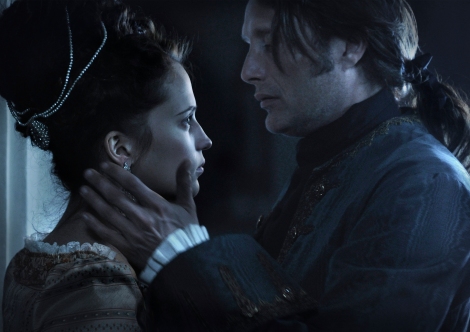
The royal couple attempts to bring reform to Denmark in A Royal Affair.

Many Americans might expect the Danish film A Royal Affair to unspool as a dry history lesson—though the movie is more like a political thriller with powdered wigs. But for Nikolaj Arcel, the film’s director and cowriter, the 18th-century story of Dr. Johann Friedrich Struensee, Queen Caroline Mathilde, and King Christian VII remains resoundingly contemporary. Though the forward-looking physician and the good-hearted if naïve royal couple tried and failed to bring reform to Denmark, they paved the way for the next generation to effect lasting change.

“It’s almost impossible not to know this story if you’re from Denmark,” Arcel says. “Every school kid knows it. So it was more a question of getting to a point of where I was mature enough to do the film. I’d been thinking about it for some time. It was a bit of a daunting prospect. I spent a year writing the script and then about four years trying to finance it. So it wasn’t that easy. In fact, I did a whole other film while waiting for financing.”

Germans and Britons had previously filmed the story, but apparently poorly. Yet no Dane had succeeded in getting it to the screen, despite repeated attempts. “A lot of great directors, even idols of mine, had been trying to make it,” Arcel says. “It was sort of like: Let me try and fail like the others. And we almost failed. There were times I felt we’re never going to make this. I was actually quite depressed for a while.”

But Arcel did succeed. The film has done huge business in Denmark and fared extremely well in the U.K., Australia, and France. Arcel had never directed a period drama before, and he owns up to having felt intimated by the prospect. “I was terrified, actually,” he says. He didn’t even have the comforts of home to console him, for re-creating 18th-century Copenhagen proved impossible in 21st-century Denmark, and the Czech Republic had to substitute. What drove him forward were the progressive ideas at the heart of the film.

“I’m a little bit of a political nut,” the filmmaker says. “There are some movements in Denmark and also here in America that are moving away from the Age of Enlightenment. I have quite a liberal viewpoint. I truly believe that every man is equal and should have an equal chance in life. And that’s what Struensee fought and died for, and it’s something we have to keep fighting for—rationality rather than irrationality.”

Kon-Tiki is a re-creation of Norwegian adventurer Thor Heyerdahl’s epic trek across the Pacific, from Peru to Polynesia.

It could be said that the opposite—irrationality over rationality—drives the figures at the center of Kon-Tiki, a re-creation of Norwegian adventurer Thor Heyerdahl’s epic trek across the Pacific, from Peru to Polynesia, which is codirected by Joachim Rønning and Espen Sandberg. Some older Americans might recall this incredible feat, which occurred in 1947, but many more know of it through Heyerdahl’s bestselling book, also titled Kon-Tiki, and the identically named documentary it inspired, which won an Oscar in 1951.

But Rønning and Sandberg’s enthusiasm for this story goes far beyond that of an armchair explorer. Like Arcel and his film, these helmers—who have been making movies together since they were kids—feel a personal tie to the tale they tell. “Thor was extremely well known, maybe the biggest celebrity of all in our country,” Sandberg says. “But he was even more important to Joachim and I because he came from the neighboring town, even smaller than ours. And he made the life he wanted for himself. And in that sense he was a huge inspiration for us becoming directors. In Norway, you’re not really supposed to stick your nose out, so to have a man like that from almost the same place as ourselves was a great inspiration.”

Though Sandberg allows that Kon-Tiki didn’t necessarily have to be made by Norwegians, others had tried and failed, including Hollywood. “We’ve been working on it for four years,” he says. “We tried to get ahold of it earlier because we were so interested in it, but we were told to forget about it. As the saying goes, luck is where persistence meets opportunity. And this movie is bigger than the system here in Norway allows. There’s only 5 million of us—a number we hit just three months ago.”

The shoot required four weeks on the open sea and another four in a tank, with the production based in Malta. The raft they used could hardly have been more real, as it was the same one, slightly modified, that Heyerdahl’s grandson used to re-create his grandfather’s famous voyage. As for the realistic-looking shark scenes, Sandberg owns up that “all the sharks are Scandinavian”—in other words, virtual, thanks to CGI technology.

Regarding the division of labor, Sandberg jokes that he and Rønning alternate at the helm “every other day.” But seriously: “We grew up together in this small town and have made movies together since we were 10,” Sandberg says. “So the process evolved with Joachim taking care of visuals and me talking to the actors on set. But we talk about everything all the time. And because we’ve always done it this way, it’s completely natural.”

Supporting Actor/Actress Handicap

Pete Hammond is Deadline’s awards columnist. This article appeared in the Feb. 6 issue of AwardsLine.

This season’s supporting actor and actress Oscar races can be summed up in one word: Winners! A remarkable seven of the 10 nominees actually already have at least one Oscar on their mantel, and all of them have been previously nominated. Unlike the marquee lead races, not a single newcomer has been invited to the supporting party. In fact, all five supporting actor nominees are past winners, a rare occurrence that proves Feb. 24 will indeed be veterans’ day at the Dolby Theater. And though there is a strong frontrunner emerging for the women, the male race is one of the most wide open in years, with no one taking the lead to date and the outcome a real question mark. So how did they all get here? Here’s the rundown.

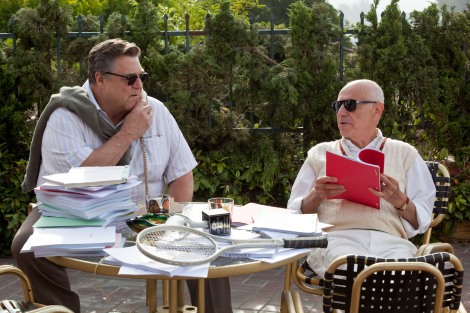
John Goodman, left, and Alan Arkin play Hollywood insiders who collaborate with the CIA in Argo.

SUPPORTING ACTOR

Alan Arkin | Argo

This veteran actor got his first lead actor Oscar nomination in 1966 for his film debut in The Russians Are Coming, The Russians Are Coming. And then a second just two years later for The Heart Is A Lonely Hunter. But it was a near-record 38 years before Arkin returned to Oscar’s inner circle, finally winning a supporting actor prize for Little Miss Sunshine. Now, six years later, he is back in contention as the Hollywood film producer in Argo, and the reason is simple: He not only gets the best lines, he’s playing the kind of industry insider that Oscar voters will instantly recognize. As Lester Siegel, who becomes the fake producer of a fake film created to free six American hostages in the 1979 Iranian hostage crisis, Arkin is perfection, delivering his lines with the kind of droll style for which he is known. He plays a character that, oddly enough, makes Hollywood proud of what they do: He uses a schlocky script to save lives and make a difference, instead of making money.

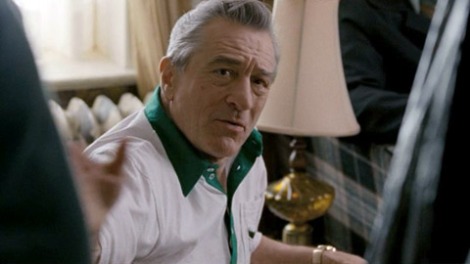
Robert De Niro as Pat Sr. in Silver Linings Playbook.

Robert De Niro | Silver Linings Playbook

One of the most revered—if not the most revered—living actor, De Niro has won two Oscars and been nominated six times. Remarkably, his last nomination came 21 years ago for Cape Fear, and since then he has been criticized in some quarters for taking on too many commercial projects (Fockers, anyone?) and not enough so-called Oscar worthy roles. However, with films like Casino and Heat to his credit in the interim, this isn’t really true: He’s got one now for which he scored a touchdown. As Pat Sr., the obsessive-compulsive Philadelphia Eagles-loving family man, De Niro has some of his richest moments on film in years. He’s alternately funny, touching, and real. Clearly, the actor in him was energized, and the role fit him like a glove. As Pat Sr., De Niro is back in the (Oscar) game, and that might be irresistible for Academy voters, who have been waiting since his iconic role as Jake La Motta in 1980’s Raging Bull to find an excuse to give this legend another statuette.

The Master
The awards-buzz worthy performances of Joaquin Phoenix, left, and Philip Seymour Hoffman in The Master are worth more their weight than B.O.gold.

Philip Seymour Hoffman | The Master

Hoffman won best actor for playing Truman Capote just a few short years ago, and now he’s managed to find another great role suited to his immense talents. In the same year he wowed Broadway as Willy Loman in a landmark new production of Death of a Salesman, Hoffman won raves as the title character in Paul Thomas Anderson’s The Master, playing Lancaster Dodd, the L. Ron Hubbard-style founder of a religious cult in the early 1950s. Reaction to the movie among filmgoers was decidedly mixed, but nearly everyone agreed Hoffman was brilliant, going toe to toe with Joaquin Phoenix’s unbalanced Freddie Quell. In fact, though Phoenix is nominated for lead actor, both these roles are of equal weight, and that could help Hoffman, who perhaps has the meatiest role in this entire category. After all he is the Master and totally in control in scene after scene, giving this bigger-than-life character real dimension when it could have been over the top.

Tommy Lee Jones plays abolitionist Senator Thaddeus Stevens in Lincoln.

Tommy Lee Jones | Lincoln

Tommy Lee Jones won an Oscar in 1993 in this category by chasing Harrison Ford around in The Fugitive. He has a chance nearly two decades later to repeat the feat by taking on Abraham Lincoln in Steven Spielberg’s quiet epic on the fight to pass the 13th amendment. In a sterling ensemble cast, Jones has the most colorful and vivid role as Thaddeus Stevens, a deeply passionate man set on ending slavery. By contrast, Daniel Day-Lewis is positively subdued, but Jones has the kind of scenes that, quite frankly, win Oscars in this category. He could win for the wig alone. It’s a memorable turn in a very good year for Jones, and it earned him a supporting actor trophy from the Screen Actors Guild. That one-two punch in voters’ minds could remind them what a great and versatile actor he is, cinching the deal.

Christoph Waltz, left, is nominated for Django Unchained.

Christoph Waltz | Django Unchained

As Dr. King Schultz, a dentist/bounty hunter, this Austrian-born international star takes another tailor-made Quentin Tarantino character gift and socks it home with deadpan delivery, sly glances, and scene-stealing aplomb. He understands Tarantino’s rhythms like few others do, and it pays off. A winner here just three years ago for Tarantino’s Inglourious Basterds, Waltz got back in the race this time by standing out as the lone cast member of the large ensemble to grab an Oscar nomination. Largely unknown to most American audiences until he exploded on the screen in Basterds, Waltz has become a go-to character actor in a short amount of time. His role as a take-no-prisoners practitioner of bringing in “the bad guys” is a priceless reminder he’s got what it takes to win over audiences and win Oscars. Whether the Academy will want to give him a second one so soon is another question, but with a Golden Globe already in his pocket for this role, don’t count him out.

BEST SUPPORTING ACTRESS

Amy Adams and Philip Seymour Hoffman star as a cult power couple in The Master.

Amy Adams | The Master

Amy Adams is getting to be a regular in this category. It has taken her just seven years to amass a remarkable four nominations: Junebug (2005), Doubt (2008), The Fighter (2010), and now her startlingly different role as Peggy Dodd, the faithful wife who might really be the one in control in The Master. The only thing that links these four characters is the actress herself, and she got in this time taking real risks, making choices other actors know aren’t the easy ones. This is a role she seems to disappear almost completely in at times, but she gives the role its greatest power in the subtle, nonshowy way she spends each scene, never once succumbing to the temptation of going over the top and always standing head to head with costar Philip Seymour Hoffman.

Sally Field plays the complex First Lady in Lincoln.

Sally Field | Lincoln

A two-time winner for Norma Rae (1979) and Places In The Heart (1984), Field has a perfect Oscar track record: Two for two. Now this plucky veteran is back to try for a third as Mary Todd Lincoln, President Abraham Lincoln’s long-suffering First Lady. She was a cinch for a nomination because fellow actors love the grit and determination she showed just in hanging in there as the film went through development hell over the course of a decade, while she slowly started to age out of the part. Insisting on a screen test and not giving up, Field won the role by sheer will—and talent. Her powerful scenes opposite Daniel Day-Lewis prove the decision was right.

Anne Hathaway is the doomed Fantine in Les Misérables.

Anne Hathaway | Les Misérables

If there is a frontrunner in any Oscar category this year, the mantle surely belongs to Anne Hathaway, who takes the small but pivotal role of the tragic Fantine in the iconic musical and somehow not only makes it her own, but probably delivers the definitive version. In closeup, singing live, one take at a time, Hathaway is heartbreaking. Something otherworldly seems to take hold of her, so much so that it’s not possible to believe she could have nailed it over and over. There were eight takes, she says, but she only felt she got it perfect on the fourth, and that’s the one that wound up in the film. It’s not a large part compared to some others in the category, but it’s one from the heart, and that counts a lot with Oscar voters. Both Globe and SAG voters have already given her the statuette for this role.

Helen Hunt plays a sex therapist in The Sessions.

Helen Hunt | The Sessions

Helen Hunt won four Emmys for her role on TV’s Mad About You and then a best actress Oscar for 1997’s As Good As It Gets. After those triumphs, it seemed like her career got a little spotty, and she couldn’t quite recapture the magic, despite some fine work in little-seen projects in the last few years. And then along comes the true story of Mark O’Brien, a man in his late 30s living in an iron lung and who longs to lose his virginity to Cheryl, a sex surrogate played by Hunt. She clearly could relate to this woman because rarely have we seen such an open and vulnerable Hunt on screen. It might be her finest performance, one in which she is naked, both physically and emotionally. Opposite the equally remarkable John Hawkes, who was clearly robbed of a best actor nomination, Hunt got to show she still has it.

Jacki Weaver plays Pat Jr.'s doting mother in Silver Linings Playbook.
Jacki Weaver plays Pat Jr.’s doting mother in Silver Linings Playbook.

Jacki Weaver | Silver Linings Playbook

As the mother in a dysfunctional Philadelphia family, Weaver finds herself back in the same category she first appeared in 2010 in the gritty crime drama, Animal Kingdom. However, this role could not be a more different kind of mother. Weaver’s nomination might be the biggest surprise in the category because it is by far the least-showy role. Unlike her nominated costars, she doesn’t have the “big scene,” there are no real histrionics, no big laugh lines, no heavy drama. She’s just real, and as director David O. Russell says, “She manages to be the heart and soul of this movie.” Roles like this don’t often get recognized because they seem so effortless. You never once catch Weaver acting, and that’s a rare gift.

Q&A: Alan Arkin On ‘Argo’

Pete Hammond is Deadline’s awards columnist. This article appeared in the Feb. 6 issue of AwardsLine.

With a best actor Oscar nomination for his very first film, the comedy The Russians Are Coming, the Russians Are Coming, and a second one for the drama The Heart Is A Lonely Hunter just two years later, Alan Arkin got off on the right foot early in his career. It would be 38 years later before he got a third nomination, and it turned out the third time was the charm when he won best supporting actor for Little Miss Sunshine. But don’t think the long wait to get to Oscar’s stage mattered much to Arkin. He has a tough time dealing with the whole idea of competition between actors and is happy just letting his work speak for itself. This versatile actor, who is now 78 years old, is still going strong all these years after getting his start as a founding member of The Second City comedy troupe in Chicago. Memorable performances in films as varied as Catch-22, Wait Until Dark, The In-Laws, Glengarry Glen Ross, Edward Scissorhands, and so many others have marked a long career that seemed to win a second life after the Oscar. His fourth nomination is for Argo, in which he plays the ultimate insider Hollywood producer, Lester Siegel, who is called upon to use his expertise in a very different and important way. In typical fashion, Arkin hits it out of the park, and also in typical fashion, he’s not bragging about it.

AWARDSLINE: Argo has passed $100 million at the boxoffice domestically. Did you have any idea that this movie would be that kind of hit it when you got involved?

ALAN ARKIN: I never think about it. I don’t spend a lot of time concerning myself about the grosses. I thought it might be possible—I get a bump in my salary then I start caring. (Laughs). Otherwise, it’s not something I care about. It’s just something I want to do or not.

AWARDSLINE: So what attracted you to playing Lester Siegel?

ARKIN: I felt like I knew the guy. I felt he was wonderfully humorous, completely real. I mean, it was a lot of funny material, but I felt it served the entire piece. Stylistically, it’s the way movies used to be. You (would have) a serious movie and have no problem with having comedic elements in it. For some reason, that seemed to change over time, and this film brings it back to where you can have a serious moment and pull out some humor. I love that idea.

AWARDSLINE: Why do you think it changed? Argo does seem to be embraced by people in the industry, because it is something that feels different now.

ARKIN: (The business is) more corporate and more formulaic and less experiential.

AWARDSLINE: What makes you say yes to a project these days?

ARKIN: It’s a combination of things, like a graph. It depends how high something goes on the graph: It could be the director, the script, the part—it could be any one of those things alone if I feel strongly about it. There are times when I like the character and not the director, or the other way. Usually it has to be a combination of the three.

AWARDSLINE: There’s Oscar buzz this year for you in Argo. Does that mean something to you at this point in your career?

ARKIN: It’s a euphemism for people telling you they like your work. I had a hard time treating my field as if it’s horse racing, putting actors in competition against each other. I see how the industry and the studios feel it’s important, but I don’t really have a feeling for being in competition. I want to feel sympathetic and close to others, not opposed to them. Every physicist knows that things connect with each other. To isolate things is not the way the universe works—winning best actor is arbitrary.

AWARDSLINE: But you are one of the rare actors to get an Academy Award nomination for best actor on your first feature film, The Russians Are Coming, the Russians Are Coming.

ARKIN: It was one of the many times in my life where I disappeared. Somebody was in my body and answered for me. I went away and didn’t come back until the awards were over with. Somebody was there, I have a vague impression of it, but I just ran away.

AWARDSLINE: I was at a recent screening of the film, and it still holds up.

ARKIN: It’s a sweet film; I love it. My main memories of that were that (director Norman Jewison) ruined me for the next 10 people I worked with. He was so extraordinary to work with. It was like a dream come true. It was a totally embracing experience in every way. Norman got the entire town involved in shooting; everybody in the town was an extra. Everybody was invited every day, to the point that they had to ask people to keep their children home and doors closed because we couldn’t hear the sound guy. It was to me what I always hoped movies were going to be. But it didn’t happen again very frequently.

AWARDSLINE: That nomination led to a lot of great movies for you, including Wait Until Dark with Audrey Hepburn.

ARKIN: She was a dream, she was everything you had hoped for. I was a little bit tongue-tied around her. She was very accessible, very hardworking, great sense of humor—but regal.

AWARDSLINE: You really terrified her, and she was playing a blind woman.

ARKIN: I had a miserable time because I liked her so much. I couldn’t stand what I was doing to her—very unhappy about it.

AWARDSLINE: Do you like doing theater? You were so successful on stage; you won Tonys.

ARKIN: I would rather die than do a play—10 years in solitary instead. Here’s how much I want to do it: If you told me I could rehearse this play for two days and perform it for one night with the book in my hand, you said you’d pay me $10 million, and not only that but (we’d have) world peace for the next 50 years, I’d have to think about it for six months. And then I’d say no. The repetition of it drove me crazy—nothing creative about it for me. I need to be inventing and playing, and not doing the same thing over and over again.

AWARDSLINE: But you did spend a good amount of time on stage as a founding member of The Second City…

ARKIN: Once I got to Second City, I found the kind of acting I enjoyed. We’d do a show for three months, then the next show would be based on improvisations that worked on the show before that. (It was a) constantly rotating series of set improvisations.

AWARDSLINE: How did you initially get involved in it?

ARKIN: A friend of mine married a guy named David Shepherd who was one of the founders of Campus Theater, and we did a thing in St. Louis in the summer—improvisational theater. Paul Sills, who no one had ever heard of, came down and told me if I ever wanted a job a Chicago to give him call. I said, “Fat chance. I’m going to have a big career in New York, so I’m not going to bury myself in Chicago.” After starving for six months in New York, I called him, and I thought I’d be there for the rest of my life earning $800 a week. Six months later, it got national attention, (and) it was the beginning for me.

AWARDSLINE: Do you still love the business?

ARKIN: I don’t love the business. I never wanted to be a part of it. I don’t think any actor does. Most of the time, I’ve been really fortunate to work with people who are really fun to work with. It doesn’t mean we don’t take it seriously, but no one is under the delusion (that we’re) bringing world peace for the next 100 years. If anybody told me 40 years ago what would be happening, I’d think they were crazy.

Nommed Cinematographers Discuss Key Scenes

Thomas J. McLean is an AwardsLine contributor. This article appeared in the Jan. 30 issue of AwardsLine.

In a year filled with remarkable imagery, the work of the Oscar-nominated cinematographers stands out as integral to the success of the movies they shot.

The nominees bring broad experience to their films. Seamus McGarvey, nominated for shooting Anna Karenina with director Joe Wright, came to the project off the summer blockbuster Avengers; Robert Richardson shot his fourth film with Quentin Tarantino with Django Unchained; Claudio Miranda went both digital and 3D to lens Life of Pi for Ang Lee; Janusz Kaminski made his 13th film with Steven Spielberg in shooting Lincoln; and Roger Deakins ventured into the world of James Bond with Skyfall.

AwardsLine asked the five nominees for Oscar’s Best Achievement in Cinematography to pick a key scene and break it down in detail. The choices, like the nominated films themselves, speak to the challenges inherent in the craft and its essential importance to making a movie.

Anna Karenina
Seamus McGarvey’s work in Anna Karenina served to demonstrate how Anna and Vronsky connected on the dance floor.

Seamus McGarvey

The Scene: In a single sweeping, shot Vronsky (Aaron Taylor-Johnson) leads Anna Karenina (Keira Knightley) on the dance floor at a high-society ball, with their electricity igniting movement from the other dancers. They connect in a moment of silence, and, for a moment, the auditorium is empty before the dancers return, bringing the star-struck couple back to reality.

Behind the Scene: “(Director) Joe (Wright) worked very closely with Sidi Larbi Cherkaoui on the choreography of the scene, and the actors rehearsed it very much in advance to create a gestural language for this dance—one that wasn’t a classical waltz; it was fresh and modern and expressive. What we also explored with it was the idea of the photography shifting in its personality during the take, so we would migrate from a kind of an objective point of view to a subjective one within the same shot, and that the camera would shift perspective within the shot and then back again. From a lighting point of view, it allowed me to experiment with lighting that I had never tried before—theatrical lighting within a movie setting. All those things make it gently distinctive in terms of the film. On the day of, we had a plan for how we would shoot it, and we spent quite a bit of time planning the shot and planning the choreography. I had a huge amount of work to do in terms of programming the lighting changes because even as the camera is moving around in a circle, there are quite complex shifts in the lighting that I was controlling on a wireless pad, with which we were able to cue the lights live to preprogrammed settings. There were probably 30 or 40 cues in that one shot. But it has a simplicity. You don’t want to overwhelm the shot or the emotion of the shot with trickery.”

Django Unchained
Robert Richardson used two cameras–unusual for Quentin Tarantino–to capture the emotional scene in which Broomhilda (Kerry Washington) is whipped.

Robert Richardson

The Scene: A flashback, in which Django (Jamie Foxx) fails to convince the Brittle brothers not to whip his wife, Broomhilda (Kerry Washington).

Behind the Scene: “The style is wildly different than the majority of sequences within Django Unchained. When Quentin talked to me of the scene, he asked that we shoot with two cameras, which is quite rare for us. He knew that an emotion and a spiritual space would be found once we began filming, and he wanted to capture that. Spiritual is an understatement. Shooting the scene was an act of enlightenment. Both Jamie and Kerry poured their hearts and their souls into the sequence. To watch the acting on set was extremely difficult for me, as it moved further and further away from acting or as I moved further and further from perceiving it as acting. When I was photographing Jamie, I noticed clouds race across his eyes then mist raised as he fell to his knees begging, tears sliding down his cheeks. Kerry was tied tightly to a wooden frame, stripped of her clothes, and one of the Brittle brothers pulled back a whip and fiercely let go. Kerry lurched from the lashing. Her screams stopped everyone on the set. I began shooting within a state rarely achieved: A blind desire to capture this particular moment that was so very real that, in hindsight, I know was out of place for a feature film. Deeply provoked and touched by the acting, which appeared to disappear as we settled into the past. It was as if we were transported through time. The setting, meaning the location, was on Evergreen Plantation, which is listed on the National Register of Historic Places. Two-hundred-year-old live oaks covered the property. Beneath these stunning trees sat 20 or so slave quarters. Ironic to have such beauty atop such hideous history. We filmed amidst those slave quarters. Haunting. A vital slap of reality. What was extremely challenging was to maintain a vision for the scene when the events within the frame were as powerful as these were. Documentaries can mirror the moment described above. But I have experienced few in my career that rival.”

Real candles lit this scene in Life of Pi.

Life of Pi

Claudio Miranda

The Scene: Young Pi (Gautam Belur) attends a spectacular candlelit ceremony with his Hindu mother as his older self narrates his and his family’s differing views on religion.

Behind the Scene: “It’s supposed to be big, with lots of light and spectacle. So I thought it would be really beautiful to try to fill this place with tons of candles. And I said, ‘Wouldn’t it be great if we could totally light the space with candles? How many would it be?’ And we were kind of walking around and measuring, and Ang (Lee) was talking like we should have one for every square foot. That’s 50,000 candles! We had to have that lit for the whole night, so I think we ordered 120,000. I don’t think it still was enough, and we added more with CG. The story was a little bit more about the mother—this was her religion, and they were taking her to this place and she was very introspective at that moment. That was shot pretty early on, just outside of Pondicherry. It was a scene about getting the kid. The kid was young and sometimes a little bit hard to get. We did know the beats. and we did go through those beats, and we wanted to be getting some angles on top—and we shot until the sun came up.”

The president walks slowly down the hall, heading to the theater for the evening.

Lincoln

Janusz Kaminski

The Scene: Having successfully passed the 13th amendment and ending the Civil War, Lincoln (Daniel Day-Lewis) is reminded he is due at the theater and walks down the halls of the White House toward a greenish window and the exit.

Behind the Scene: “It’s not a difficult shot. I just like the metaphor of it, and that’s what makes it special. I chose that shot simply because it represents the metaphor of what is going to happen. This is the last time we are seeing him, except for his death bed. And I like that he’s going toward slightly greenish glass, which resembles the light on his death bed, which had a little bit of a greenish quality. He’s almost walking toward an unknown future, which as we learn quickly, it’s death. One of the difficulties was to find the proper choreography between Mr. Slade, who was his servant, who was trying to remind the president about taking his gloves with him, and the pace and direction of the president walking toward that glass window. I think we had done several takes, because somehow we couldn’t get the coordination between the camera and the actors’ movement. I also remember it was very dimly lit. It was probably not the brightest set that I’ve done in that particular movie. We wanted a bit of a silhouette of Lincoln going toward the exit of the White House. We all know what happens to him, and it’s a combination of sadness because he’s going to die but yet it’s not a completely depressed scene because he’s achieved so much.”

Skyfall
Roger Deakins lit this scene in Skyfall with an actual LED screen and shot on a stage.

Roger Deakins

The Scene:  James Bond (Daniel Craig) engages his target, a professional hit man (Ola Rapace), in a fight to the death in an under-construction skyscraper illuminated by a massive LED screen at night in Shanghai.

Behind the Scene: “It’s one we shot early on, and I felt I was taking a chance by suggesting or pushing for that kind of look, the big LED screens and light and the whole set just with those source lights that you see in the shot. Also the fact that we did it on stage as opposed to a location, which was the original intention. And I was quite pleased the way it turned out. When it’s one of the earlier scenes in a shoot, you feel a sense of relief that you’ve achieved something close to what you had in your mind’s eye when you started. We spent a lot of time prepping. Obviously it was a big stage set, and there was a lot of very particular lighting that was built into the set. We spent actually weeks and weeks testing a few different big LED screens for the playbacks. And then we had to order a particular one we liked, which was a combination of being a fine pixel count and also being practical to do in the size we wanted, because it was about 60 by about 40 or 50 feet, I think. And we had to find one we could rent for the period we needed it and, in fact, it was available for only a small window of time, so we had to shoot the scene and then it had to be broken down and sent back before we had really cut the scene. It was a bit of a risk in it, really. But it was good being on stage at Pinewood because we were shooting there quite a bit, and I could go in at the end of the shoot day and look at the lighting and just gradually build it. ”