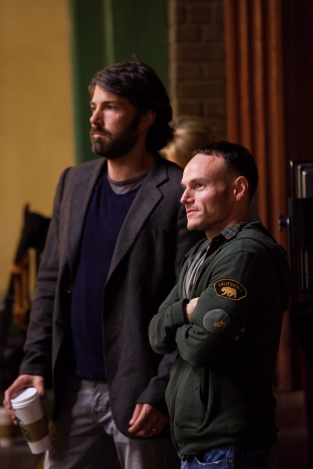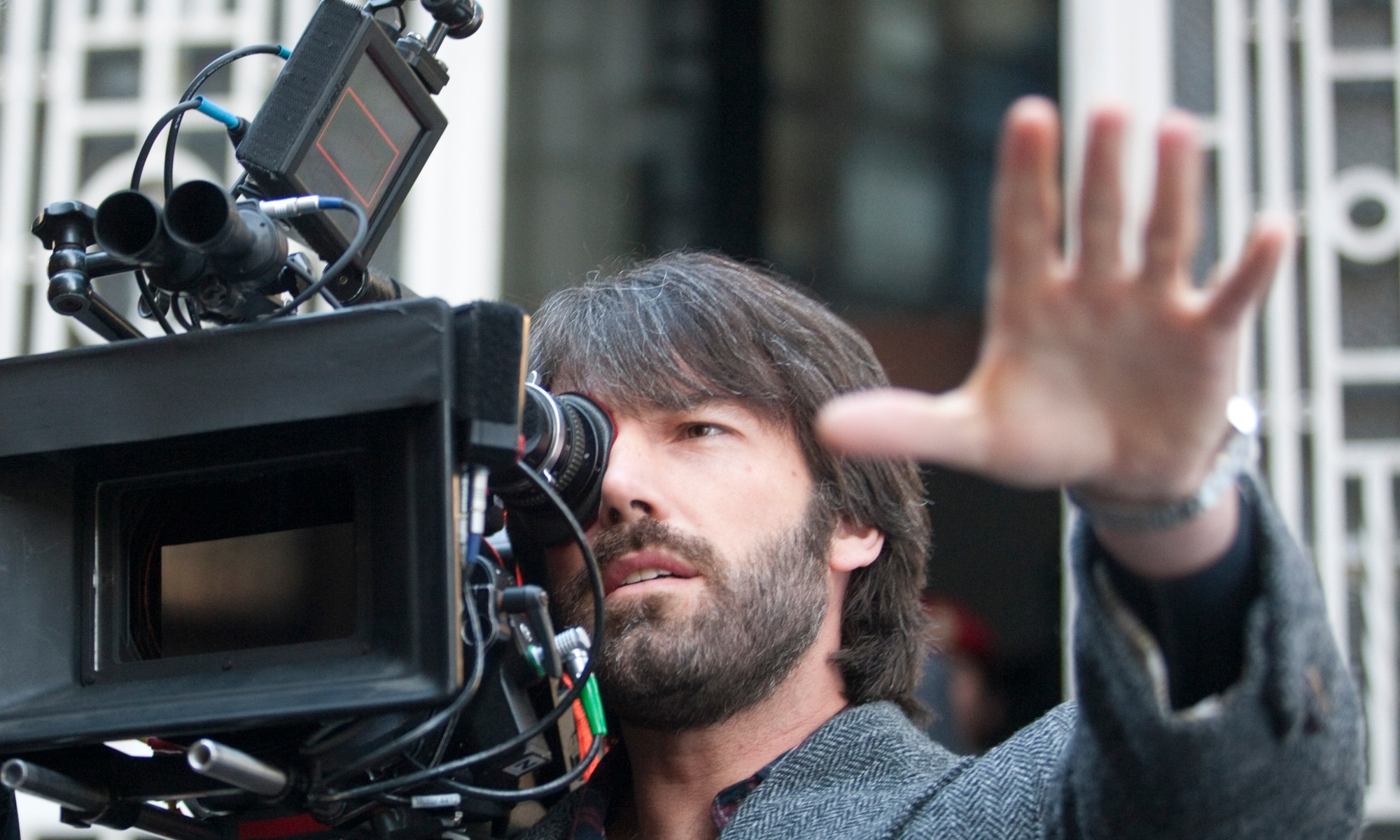
Q&A: Sacha Baron Cohen On Les Mis

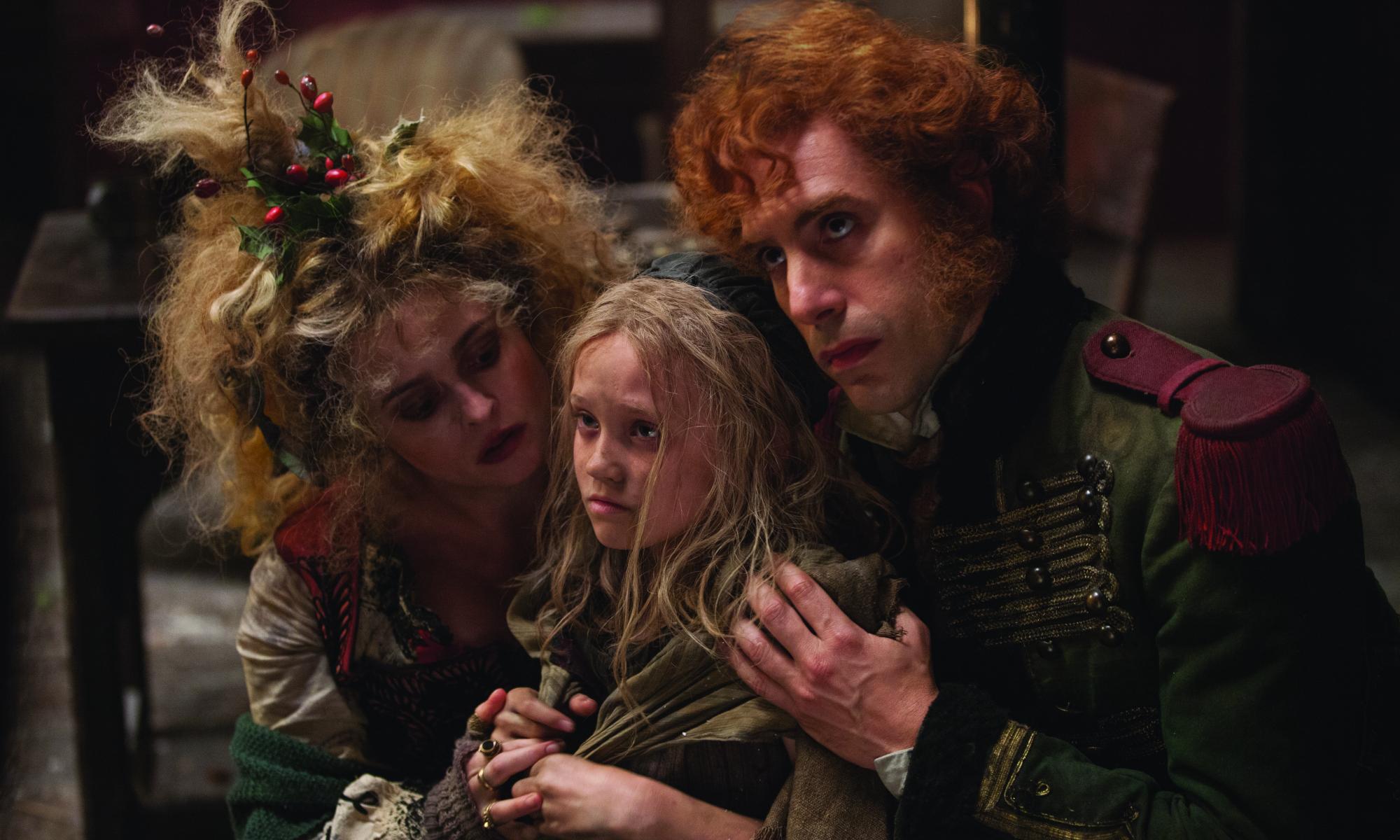
While awards voters traditionally underestimate the merits of comedians, Sacha Baron Cohen is the best possible proof that a comedic actor can possess a wider range than his dramatic counterparts. Like his idol Peter Sellers, Cohen arrests stereotypes and authority figures through his iconic personalities (flamboyant Austrian fashionista Bruno Gehard; the blunt Kazakhstan journalist Borat Sagdiyev, and the fierce Middle Eastern totalitarian Admiral General Aladeen as featured in last summer’s comedy The Dictator). However, Cohen has a leg up on Sellers in that his alter-egos brilliantly cross the line, as he throws them into real-life clashes with celebrities and politicians, often exposing their prejudices and shortcomings. Equally balancing Cohen’s outrageous laugh facets is his ability to escape into serious roles, (read his turns as Signor Adolfo Pirelli the Barber in Tim Burton’s adaptation of Sweeney Todd: The Demon Barber of Fleet Street, the station inspector in Martin Scorsese’s Hugo). This holiday season, Cohen continues to generate buzz in his second musical role following Sweeney Todd as the duplicitous innkeeper-cum-master of the house, Thenardier, in Tom Hooper’s Les Misérables—a part Cohen takes to another level with his own sense of humor. In 2007, Cohen received a best screenplay Oscar nomination for cowriting Borat: Cultural Learnings of America for Make Benefit Glorious Nation of Kazakhstan. This year, he shares an ensemble award SAG nomination for Les Misérables as well as a National Board of Review ensemble win.

AWARDSLINE: How did the role of Thenardier come to you? Was this a project you always wanted to be a part of?

SACHA BARON COHEN: Actually, I only have a history with Les Mis in that when I came out of university at age 20 or 21, I went through an open audition for the chorus in Les Mis—not even one of the named roles. And there were about 300 people who were lining up outside the Palace Theater in the West End, and I passed the first audition, which was singing, and then they had a group audition for dancing, and they taught a little routine. I had no idea how to learn choreographed steps, and so I just decided to freestyle and came to the actual audition. There were seven people doing perfectly choreographed steps and then me just doing some very bad breakdancing in the corner. I did not get the role. So, there is a history.

AWARDSLINE: You’ve also done some musical theater previous to this. You were in Fiddler on the Roof.

COHEN:At the University of Cambridge, I did Fiddler on the Roof and My Fair Lady, and obviously was in Tim Burton’s Sweeney Todd. I played Tevye in Fiddler and grew my first beard for that. And in My Fair Lady, I played Alfred Doolittle, which is not a million miles away from Les Mis in that you come on for a little bit, have a couple of nice songs, and then spend the rest of your time in the dressing room.

AWARDSLINE: Was there really this rigorous audition process for Les Mis where the actors had to go in for six weeks?

COHEN: Truth be told, it was slightly brief with me. I heard that Tom Hooper was interested in me for the part, and then I did actually audition. I had to sing—he made me sing a number of songs from Fiddler on the Roof. Even though he actually kind of sprang the audition on me; he came to my house and there’s a guy with him. I asked, “Who’s this guy?” And he basically was a pianist, and then the electric piano arrived, and then Tom made me sing “Master of the House” for him, which I thought terribly unfair because I hadn’t prepared for it at all and hadn’t really sung it since the age of 15 when I first saw it in the West End. It was the humiliation of having to sing a bunch of songs for Tom Hooper in my kitchen.

AWARDSLINE: What were some of the Fiddler songs you sang for him?

COHEN: He made me sing “If I Were a Rich Man,” which, funny enough, I auditioned with for Tim Burton, as well, because when I auditioned with Tim Burton, Stephen Sondheim had to approve all of the actors. Then Tom made me sing all of Thenardier’s songs from Les Mis. I did offer to sing Hugh Jackman’s songs, but he wasn’t interested.

AWARDSLINE: And what’s wonderful is that Tom really gave you room to be you in the role Thenardier.

COHEN: That’s one of his great strengths. I think he’s a fantastic director, but what you get with directors of that stature is there’s a lack of ego, which I also noticed with (Martin) Scorsese when I was doing Hugo. Tom and Scorsese are so confident in their own craft that they’re happy to sometimes give over the reins when it’s a comic number or when there’s a comic side to the piece. So Tom was very happy to listen to every idea and to try and work out something that was different to the stage show and would be unique but also something that could remain authentic to the whole character of the film. I mean what he was worried about was that the piece or two would stand out and would not blend in with the whole genre. So that’s not really worth the challenge. I’ve got to say (singing live during Les Mis) was one of the reasons that I got excited about the project because when I was in Sweeney Todd… when it came to singing my number Tim Burton wanted me to mime along to the track that I recorded a month beforehand. At that point (when I recorded it), I didn’t have a costume; I didn’t really have a fully-formed character, and I didn’t have an incredible set around me with 200 extras. So I pleaded with him to let me sing live because as an actor I need to respond to stuff that’s going on in the moment whether it’s the audience or the actor I’m playing opposite. Particularly jumping off Borat, I wanted to have the song feel authentic. It was a challenge because it was a traditional musical. So I finally convinced Burton to let me sing a couple of takes live and actually they were used. When I first read for the part of Thenardier, Hooper and I talked about (singing live). It’s an exciting idea—singing a musical live—because you can react to things in the moment, and it allows me in the movie to have little asides and throw a little bit of dialogue in between.

AWARDSLINE: I understand Tom Hooper would shoot a song as one long entire take.

COHEN: Yes. This is really challenging, particularly when it’s “Master of the House,” which has a lot of business in it. I mean the problem with these very long takes was that eventually it gets grating on the voice. After a month, I actually lost my voice. And I said to Hooper, and this is actually a testament to him, “Fine, I’ll just mime it. I’ve got the track of me singing, and I’ll just mime it.” And he said, “Absolutely not. It has to be sung live.” And so they shut down the movie. They shut it down for a week during which time I was forbidden from speaking. I was on voice rest. And they brought in Chris Martin’s vocal teacher,who’s the head of voice at the Royal Academy of Music, to train me up again in three days for the “Master of the House.” But when you see the first take of “Master of the House,” it sounds like I’m a drunk guy who’s got a croaky voice but that actually was me with a very croaky voice. Tom Hooper found himself with Helena Bonham Carter and a soft-voiced, stumbling English actor; it was like The King’s Speech all over again.

AWARDSLINE: You’ve mastered the docucomedy whereby you can be a character, interact with real people and elicit a reaction from them. As you became more popular with Borat and Bruno, are these types of films harder to pull off now? Are there places in the world you can still go where people don’t know who you are and pull a stunt off?

COHEN: I mean there probably are places, but the reality is you want to have—when you make a movie like that, you want to make sure that the people you’re interviewing are deserving targets. So you don’t just want to interview some doorman at a hotel; you want to interview the incredibly wealthy guests at the penthouse, high-ranking politicians or people who are threatening. The problem is it is definitely challenging, especially now with Twitter and Facebook. It’s very, very hard to get away with.

AWARDSLINE: Is this one of the reasons why you shifted gears with The Dictator, which was more fictional; still a character but placed in a fictional setting?

COHEN: I wanted the challenge of trying to make a really funny movie that was scripted, but also satirical. I did consider for a while having a Middle Eastern dictator character in the real world, which could have arguably been more satirical to see how people would have done anything for money, you know, which essentially they did with all of these Middle Eastern dictators. There’s a huge hotel in London all the studios use which was built by Colonel Gaddafi, and it’s down the road from the London School of Economics where he was given an honorary doctorate. So essentially these dictators were given carte blanche in any of the western countries that needed their money. It was tempting to take that character into the real world, but I wanted the challenge of creating a comedy script that had improvisation in it as well.

AWARDSLINE: This reminds me of diplomatic immunity whereby foreign ambassadors and their wives, particularly those at the United Nations, have this kind of untouchable privilege here in the states: If they ever shoplift in a store, they can never be prosecuted to the fullest extent of our laws.

COHEN:Yes, dictators certainly have that now. Look around London, and it’s seen as a haven for dictators. With this particular hotel I’m referring to, there are private rooms in the spa for Gaddafi’s children to enjoy themselves in any matter they see fit. What was interesting while making The Dictator were all these organizations that have to show respect to dictatorships, for example, the United Nations. We wanted to shoot a scene there, and they eventually refused us. We asked why, and they said, “Well, we represent many, many dictatorships, and we don’t want to upset them.” So, in the end, we had to re-create our own version of the United Nations. It was ridiculous, really. You know, they said the problem with our movie is that it’s antidictatorship.

AWARDSLINE: In terms of your future projects, you are preparing The Lesbian at Paramount Pictures about the Hong Kong billionaire who offered $65 million to any man who would marry his daughter.

COHEN: Yes, the project about Cecil Chao. I’m working on that at the moment. I’m actually writing a couple of things at the moment and deciding which one to get very excited about.

AWARDSLINE: I have to bring up what happened at the Oscars last year.

COHEN: I can already probably give you my answer before you finish your question.

AWARDSLINE: Was it a publicity stunt, or was it not a publicity stunt?

COHEN: In regards to…?

AWARDSLINE: Admiral General Aladeen appearing on the Oscar red carpet.

COHEN:Well, I mean, Ryan Seacrest was not in on it at all. He was told about an hour beforehand that he would get an interview with me, but he had no idea what was going to happen. He was very excited at the time. In regards to the rest of them, no, it was very real. The Academy did ban me from the awards, and I was. In fact the head of the Academy called up my agents and said if I was to turn up within a half a mile of the Academy he would have me arrested by 200 FBI agents. And then when I turned up as Aladeen, and finally they gave in, the police actually stopped me, surrounded the car, and decided that it was imperative that they search the car. I asked, “For what reason?” and they said, “Well, we’ve been told that you’re bringing in live ammunition into the Oscars.” And so, obviously inside the limo I had a few virgin guards and the urn. I was scared that he was going to go inside and find the urn and ask, “Why have you got Kim Jong-Il’s ashes in your car?” And then I luckily managed to slightly embarrass the cop because I said, “Listen, if you want to search the car, fine. You can strip-search me, and you can strip-search the girls.” And he looked at the girls, got embarrassed, and said, “No, you guys are fine.” You know, the whole thing was very real. With the urn, we asked ourselves, “How are we going to smuggle it into the Academy Awards?” So I decided to camouflage it as a vase. If you actually have a look in the back of one of the video shots, you can see the guy taking off the camouflage and taking away the flowers and turning the flowers into an urn.

AWARDSLINE: Heck, this is show business. It’s a new year, the Academy has a new president, ill will certainly has to have withered since last year’s scenario, no?

COHEN: Listen, I mean I’m a member of the Academy so, I think it’s an important institution. I think it encourages studios and individuals and filmmakers to make great films. Now if it wasn’t for the Academy and the Oscars, there would be less of an incentive to make movies that are not purely boxoffice hits. And in terms of ill will, I’m sure there are Academy members that would not want me back. But, no, I haven’t received anything negative at this time. At the time, they actually threatened Marty (Scorsese) and said that if he didn’t convince me to not turn up, that it would jeopardize the chances of Hugo winning, which is absurd. And by the way Marty responded, “Sacha does what he wants, and if you think I can control him, you’re wrong.”

AWARDSLINE: The sharp comedic and dramatic turns you’ve made between political/social comedies and auteur fare brings to mind Peter Sellers’ career. Is this a career path that you’ve planned?

COHEN: The reality is there’s no plan. I am incredibly lucky to have the opportunity to work with these directors. I remember, I was shocked when I first met Scorsese that he was even speaking to me, let alone I was in the same room with him. I remember we ended up having a meeting, and I thought it was going to be 15 minutes. We ended up spending three hours together, talking about the filmmaking process and just details of editing and writing. So I have been incredibly fortunate to be able to work with these directors, and for me it’s not really a plan each time I’m on a set with one of them. I think about what I can learn from them because I’m very aware that my filmmaking skills are very modest. And so with Marty, for example, I asked him very early on, “Is there any chance I could sit in the tent with you?” He has a little director tent where he watches his work. And he let me in, and for a few months I actually sat by his side and saw the master at work. If you’d told me when I was 20 that at one point I’d be sitting next to Scorsese for a few months and watch him direct I wouldn’t have believed it. Yes, these are incredible moments and there’s no plan. But if there’s an offer I can’t refuse, then I take it. I’ve only done four movies outside of my own: Les Mis, Sweeney, Hugo, and actually Talladega Nights.

AWARDSLINE: I read that you were originally cast in Django Unchained. I’ve got to imagine it was about scheduling in terms of not committing to it as a number of other actors were unable to for that very reason.

COHEN: It was. I was editing The Dictator, and we were very close to release, and Paramount wouldn’t push the date. I knew I’d have to jump straight from there into Les Mis, and it basically became a choice of either pulling out of Les Mis or pulling out of Django. I’m sure Django is an incredible movie, but it was essentially one scene.

AWARDSLINE: What was the role?

COHEN: It was a character by the name of Scotty who Leonardo DiCaprio’s character plays a poker game with. The stakes become Scotty’s slave girl, Broomhilda. [Ed. note: The final cut of Django Unchained doesn’t include the character Scotty, nor a poker game wagering Broomhilda.]

AWARDSLINE: You’re also getting ready to play Freddie Mercury.

COHEN: I am. We’re still working on the script actually. We want to get it right. There’s quite a lot of work on the script.

AWARDSLINE: Aside from what we already know about Freddie, was there anything you learned about him that many people don’t know?

COHEN: Was there anything? I mean, he was a series of contradictions. He was one of the most famous gay men, but he was also essentially married to a woman. He was one of the early celebrities, but he was also deeply private and protective of his privacy. And he was also one of the finest performers and extroverts that ever lived, but also deeply shy. So he’s a great guy to portray. For an actor, you want those contradictions, and they’re kind of a gift for any actor. I hope I’ll be able to do him justice.
Cinematographers On Their Awards Season Hopefuls

Thomas J. McLean is an AwardsLine contributor. This article appeared in the Dec. 19 issue of AwardsLine.

Don’t write that obituary for film just yet. The traditional moviemaking format remains a vital tool for the top cinematographers in the field, even as digital technology improves and offers exciting possibilities for the future.

AwardsLine caught up with the men who shot some of the year’s top contenders to talk about how they shot their current films, working with the top directors in the field, and how to make it all come together in the end.

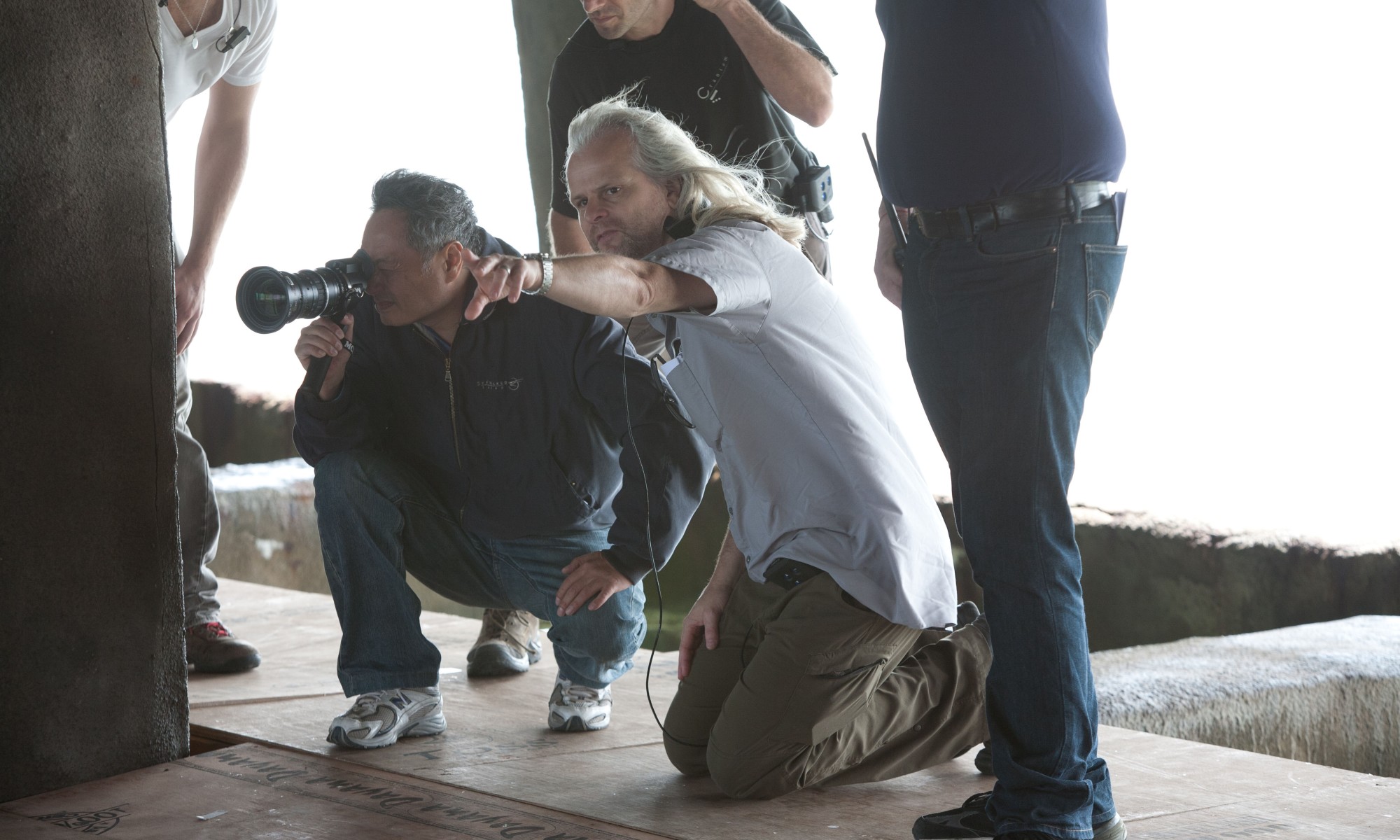
Taking part in our mock roundtable are Mihai Malaimare Jr., who used large-format 65mm film to shoot the majority of Paul Thomas Anderson’s The Master; Claudio Miranda, who shot the sole digital and 3D picture of this bunch, Ang Lee’s Life of Pi; Wally Pfister, who mixed IMAX and 35mm in wrapping up Christopher Nolan’s Batman trilogy on The Dark Knight Rises; Rodrigo Prieto, who stitched together multiple formats for Ben Affleck’s Argo; Ben Richardson, who relied on 16mm to capture the Beasts of the Southern Wild for Benh Zeitlin; and Robert Richardson, who reunited with filmophile Quentin Tarantino for Django Unchained.

Rodrigo Prieto stitched together multiple formats to create the look of Argo.

AWARDSLINE: How did you go about choosing cameras and formats for your current projects?

RODRIGO PRIETO: We wanted to differentiate the different segments of the film. We were going to intercut and wanted as soon as you saw an image, say, in Tehran that you would know that’s where you are just by the texture of the image, especially because we were shooting in very different locations.

MIHAI MALAIMARE JR.: From the first meeting we had, we were discussing using a larger format for The Master. The reason is when you think about iconic images from that period, like from the ’30s and right after World War II, you are mainly thinking of large-format still photography. We started with VistaVision, but because the difference wasn’t that big from 35mm to VistaVision, we switched to the next bigger format which was 65mm, and that was giving us kind of the feeling that we wanted.

CLAUDIO MIRANDA: Ang (Lee) was really interested in 3D. He said, “I’ve been really interested in 3D for almost 10 years now. Even before Avatar, I really wanted to see how to bring a new language to cinema.” It had to be digital, because with 3D it had to be really precise.

WALLY PFISTER: Chris (Nolan) sat back and said, “Here’s the deal: This film will stand on its own, but we are wrapping up a trilogy.” We had discussions early on about shooting in IMAX, and I said, “Dude, we should shoot the whole movie in IMAX.” But we pushed up against the limitations of IMAX, which is you can’t record synched sound with an IMAX camera—they’re just too noisy.

BEN RICHARDSON: We instinctively knew that the only viable way for our budget and to get the kind of imagery we wanted was to go to 16mm. The great thing about a 16mm camera, obviously, is that as long as you have a couple batteries and a roll of film and a changing tent, you can keep shooting.

Wally Pfister mixed IMAX and 35mm for Christopher Nolan's The Dark Knight Rises.
Wally Pfister mixed IMAX and 35mm for Christopher Nolan’s The Dark Knight Rises.

AWARDSLINE: Was it a challenge to make different formats work as a cohesive whole when cut together?

PFISTER: We go through a bit of analysis for what makes sense for that story. The obvious reason for shooting IMAX is because you want to put something spectacular on the screen that’s going to have a visceral impact on the audience. In other circumstances, Chris wants the camera to have a more of a looser, documentary feel. So you use different tools and different formats and different methods to convey the story in different ways.

PRIETO: Once we started testing all these different things, I projected them next to each other, and we saw that the looks were apparent and were visible, but we didn’t feel it was jarring, given that it was all the same aspect ratio. Also, the story has this drive to it that helps it all come together.

AWARDSLINE: How important is having an established relationship with a director versus working with someone you’ve not worked with before?

ROBERT RICHARDSON: I think having an established relationship with a director is unbeatable. The shorthand that comes from a relationship that is longstanding, especially when both sides of the party are respectful of each other, is a tremendous benefit. I’m not opposed to working with a new director, but you do have to approach it differently because you don’t know each other yet. You tend to be a little more cautious.

MIRANDA: You definitely have to figure out where directors will let you go or not let you go, and it’s all about establishing that kind of communication. With Ang, we just talked back and forth about how we feel about lighting, and he let me go a lot.

BEN RICHARDSON: Working with a director I maybe knew less well, we might have had to cover a lot of ground to find the common ground. But I think we had a fairly solid understanding of each other’s wishes off the bat, so our daily conversations in terms of shot lists and shot planning were very much in the realm of an established aesthetic that we both understood.

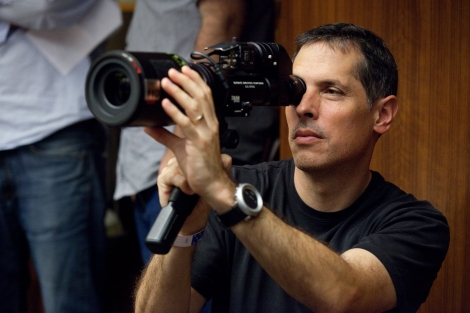
Robert Richardson on the set of Django Unchained.

AWARDSLINE: How did you approach environment and character on your film? Did you see them as separate elements or two parts of a whole?

PRIETO: On Argo, the environment plays a very important role because every situation the characters are in is based on where they are. These environments really affect the characters’ behavior and their emotional states very much in this film. I really tried to support and enhance the sense of this environment and how it’s affecting them.

BEN RICHARDSON: In terms of the environments, we didn’t so much storyboard as follow a shot list. We would go in with a sense of what we needed to achieve, but we would primarily allow the locations and the environments we found to dictate the way certain scenes could feel or could behave.

AWARDSLINE: Give one example or scene that demonstrates how cinematography was used to tell the story.

MIRANDA: I feel like the golden light is kind of a serene moment. He’s throwing this can in the air, and just the way it was captured—we shot it as a very wide shot—and he realizes that in the large ocean this is a really futile idea, and he gets really reflective. He has a little peek at the tiger, and they have a little eye connect. I feel like that was a pretty cinematic moment.

PRIETO: The one that came to my mind is when the houseguests are at the bazaar. I think the cinematography there was using the light to express this feeling of vulnerability, of being scared, and they’re overexposed—the light was several stops overexposed.

AWARDSLINE: With so many digital environments used in movies today, how do you collaborate with the digital artists who are doing everything from effects and environments to color grading?

BEN RICHARDSON: If we had been able to, we might have gone as far as trying to find a way to do a photochemical finish. So it was very important to me that that sort of photochemical feel be preserved all the way through, and I worked very closely with our DI (digital intermediary) house to do a workflow that basically emulated the way you did a traditional answer print. In regards to the visual effects, I had been a key part from the beginning in terms of figuring out how we were going to do those scenes with the beasts. I was very much in touch with Benh (Zeitlin) and the visual effects supervisor as we worked on that stuff because to me that really was the fantasy high point of the film.

PFISTER: As cinematographers, we light in a very—at least I do—visceral, gut kind of fashion, like I’m throwing paints on a canvas. The visual effects guys, they analyze lighting, and they try to re-create it, so it’s much more of a technical process for them, but they’re really starting to understand it now. Their work has gotten better and better, so for me it’s just looking at the end and commenting on whether it’s matching or not.

MIRANDA: I stayed involved in the DI. Bill Westenhofer, who did the visual effects, was there. Even the editor was there, and he was very involved in the 3D because he had made a lot of choices in the Avid for 3D placement and staging and correcting.

AWARDSLINE: What makes your job easier? What makes it harder?

ROBERT RICHARDSON: The most difficult thing would be to have a script that hasn’t yet solidified. To work with something that is in fluctuation continually can be a horror show.

PFISTER: What makes my job easy is working hard. The hardest part of the job is really if people around you are not working as hard as they should be.

AWARDSLINE: What is the most exciting development in the field? What has you most excited about the future of cinematography?

ROBERT RICHARDSON: I’m excited by the movement toward digital cinematography. I think it’s opening up opportunities for a re-evaluation of lighting, and I don’t mean in the sense that it looks like a reality show, but you can work at lower levels.

MALAIMARE JR.: I think this is a really interesting moment because you can still shoot on film for projects that you think will work on the format or you can shoot digital. What’s even more interesting is the fact that you can find really cheap digital cameras—that doesn’t necessarily help the cinematography, but it helps the audience because they are going through a self-training process. The audience is getting more aware of what capturing or creating an image can be and, of course, they have higher expectations because of that.

Behind The Scenes On Django Unchained

This article appeared in the Dec. 19 issue of AwardsLine.

“I think she had to be in there for 20 minutes before I yelled action.”

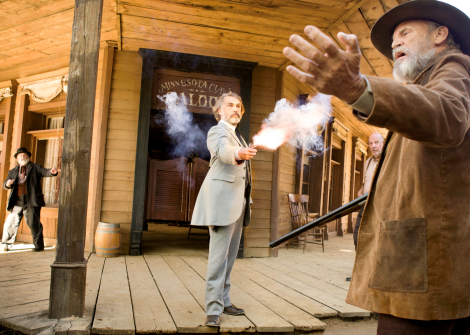
What Quentin Tarantino is specifically referring to is the time that Kerry Washington spent in the hotbox—a hole in the ground on a plantation where slaves were sent when they tried to escape. It’s where Washington’s character Broomhilda is trapped when her husband, Django (Jamie Foxx), arrives at Candyland—the vast Southern estate owned by her master Calvin Candie (Leonardo DiCaprio) in Tarantino’s Django Unchained. Her voice parched from screaming and her body weakened, Broomhilda doesn’t know that Django has come to rescue her with the help of bounty hunter-cum-dentist Dr. King Schultz (Christoph Waltz).

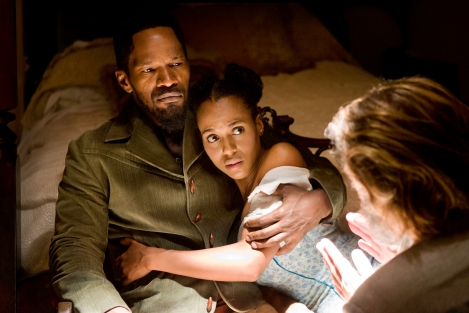
Jamie Foxx, left, and Kerry Washington star in Quentin Tarantino's mashup western Django Unchained.
Jamie Foxx, left, and Kerry Washington star in Quentin Tarantino’s mashup western Django Unchained.

“Kerry is very game to make things as real as possible,” says Tarantino, who as Waltz points out, can often inspire actors with their characters’ back stories, “Leaving her in the box for 30 seconds and then yelling action wouldn’t work. Nor would sticking her in the box for hours. But 10 minutes in the box could feel like 30. The idea was for Kerry to become disoriented, lose track of time in there, and contemplate what eight hours in the box would feel like. She could yell or scream.”

“But there was a safe word,” adds Washington, “so that the crew knew when I was panicking as a person, and not as an actor. This is how a lot of the film went—taking the reality as far as we could.”

Welcome to Tarantino’s Antebellum South. But instead of the Jewish soldiers bashing in Nazi skulls of Inglourious Basterds, it’s southern slave Django slaying a slew of white devils to get to his bride who has been sold down the river.

We know that Tarantino is the master of cool. But after his boxoffice Oscar breakout Pulp Fiction ($214 million, seven Oscar noms, with an original screenplay win for Tarantino and Roger Avary), he hit a lull. Some of his cinematic homages were relegated to cult status: His double feature with Robert Rodriguez Grindhouse collapsed at $25 million stateside, and the blaxploitation film Jackie Brown made $40 million at the U.S. boxoffice.

What happened? His style hadn’t changed. Tarantino was still the same ultraviolent, cinema vérité absurdist guy, however, he struck a nerve with audiences with his own branded subgenre: The historical wish-fulfillment tale in which the oppressed exact revenge on their oppressors. Basterds minted more than $320 million worldwide; earned eight Oscar noms, including director and picture; and turned unknown Austrian star Waltz into a supporting actor Oscar winner. When news broke in April 2011 that Tarantino was prepping a southern tale much in the same fashion as Basterds, every studio and marquee actor threw their hats in the ring.

Christoph Waltz plays a dentist-cum-bounty hunter in Django Unchained.

Basterds was something audiences didn’t know that they wanted, and that can be a cool thing—to have something that wasn’t articulated to them before,” assesses Tarantino. “They knew what other World War II movies were like and didn’t want to see the same old tired film again. The same (resonance) could follow through with Django.”

In the same way that Basterds was related to the 1978 Enzo G. Castellari film in title only, so is Django, in regards to the original Sergio Corbucci spaghetti western series (the original Django, actor Franco Nero, makes a cameo opposite Foxx in the film).

“I am only influenced by Corbucci’s oeuvre in terms of the bleak, pitiless, surrealistic west he got across. It wasn’t so much Django itself,” says Tarantino, “As the genre moved on; the name Django became synonymous with all spaghetti westerns. There wasn’t even  a character named Django in some of these movies.”

Even though Tarantino turns archetypes on their heads, quite often laced with humor—i.e. Django as the bounty hunter wears a green coat a la Little Joe’s get-up on TV’s Bonanza while a bunch of KKK men clownishly complain that they can’t see through their hoods—the protagonist’s bedrock rests on the life of pre-Civil War African-Americans. Approaching the severity of the material proved to be a grueling dramatic process for the cast.

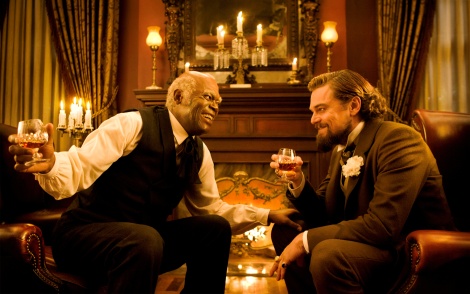
Samuel L. Jackson, left, and Leonardo DiCaprio in Django Unchained.

“I don’t know how anyone lived like this in any real way. We barely made it through for nine months,” Washington explains about the emotional pain of shooting on the Evergreen Plantation outside of New Orleans. “It just added to the resonance of things that we were embodying and portraying these crimes against humanity; that this happened on this sacred ground. There was always this dance between reality and storytelling and the heartache of both.”

To ease the atmosphere during the plantation scenes, Tarantino played gospel music between takes. Nonetheless, the haunting spirits lingered. While preparing for a day’s shoot, Washington remembers trying to take her mind off of one scene by taking in the beautiful trees around her on the plantation grounds. Upon noticing one tree without moss, Washington learned that it was the hanging tree for slaves.

“There were nights when I would text Jamie Foxx at 4 a.m. and say, ‘If this goes on for any longer, I’m not going to make it,’ ” says Washington.

“When you see Leonardo build this eloquent evil character as Calvin Candie, you want to hear those words,” says Foxx about his costar’s racist character, who doles out a monologue on the phrenology of slaves. “Hearing those words, and you hear them enough, it became second hand because that’s how they talked back then. Django is the truest depiction of slavery.”

Partnering Up

Typically, an adult film with a true depiction of slavery, or World War II, might face an uphill battle getting to the big screen. However, Tarantino is in the fortunate position of being able to finish a script, give Harvey Weinstein a call, and the project is fast-tracked from there. A meeting at the director’s house follows, where his friends and the production crew relish a grand reading of his latest work. Sure, having a studio cofinancier such as Columbia Pictures on Django enables Tarantino to get bigger budgets, but the director attributes any higher costs on his films “to moviemaking becoming more expensive. Kill Bill had a huge canvas, but I wanted for nothing.”

Universal coproduced and cofinanced half of Basterds’ $70 million budget, in addition to handling foreign, where they catapulted the film’s overseas boxoffice to $200 million-plus. But despite the studio’s passionate presentation for Django, as reported by Deadline Hollywood, the Weinstein Co. and the producers opted to go with Sony.

“Something spoke to everybody in the room when we met with Sony,” says producer Pilar Savone, who has worked with Tarantino in various capacities across five films since Jackie Brown. Despite Tarantino’s early talks with Will Smith for the role of Django, “partnering with Sony had nothing to do with the studio’s connection to Will Smith,” says Django’s second producer Stacey Sher who first produced with Tarantino on Pulp Fiction.

What is apparent is that Sony has always been passionate about being in business with Tarantino. “I remember talking to Amy Pascal at Sony about Basterds. I told her, ‘I want this movie to be a hit. I don’t want you to do this movie because it’s cool to work with me or for just the cache,’ ” says the director. “And her response to me was, ‘We really want to work with you, and we think this will be your most commercial movie.’ And the same thing with Django, so we’ll see.”

Roles To Kill For

When Smith didn’t commit to the material, Tarantino turned to six other candidates including Idris Elba, Chris Tucker, Terrence Howard, Michael Kenneth Williams, and Tyrese Gibson before settling on Foxx, who won the director over with his Texan roots, cowboy image, and his tolerance of racial issues in the current day South (Foxx even used his own mare Cheetah as his horse Tony). Casting Django was the opposite experience Tarantino faced on Basterds: If he hadn’t found Christoph Waltz to play the multilingual Col. Hans Landa, the director would have been unable to make the movie.

“Quentin was clear with every studio we met with that he wrote the role with no actor in mind. If they did the movie with him, he wasn’t going to cast one actor over another,” says producer Reginald Hudlin who Tarantino first discussed the Django concept with 15 years ago.

“A studio had to be prepared to make the film with an unknown,” adds Sher.

Despite the relentless amount of ink Django received in its casting of Kevin Costner, Anthony LaPaglia, Joseph Gordon-Levitt, and Sacha Baron Cohen, these actors’ inability to commit largely boiled down to scheduling conflicts as Django shot across several locales including New Orleans; Jackson, WY; Mammoth Mountain, CA; Big Sky Studios in Simi Valley, CA; and the Melody Ranch in Santa Clarita, CA. Costner was originally slotted to play Ace Woody, a Mandingo trainer at Candyland, while Cohen was to play a poker player Scotty who loses his slave Broomhilda to Candie. Initially, Jonah Hill was unable to commit, however, his schedule opened up, and he makes a cameo as one of Big Daddy’s (Don Johnson) KKK men.

“We had huge movie stars wanting to do day-player parts,” says Sher, “These actors are typically number one on the call sheet, so everyone schedules around them. But because of everyone else’s schedule and because of snow and weather, we couldn’t accommodate everyone.”

While Django was overlooked by the Screen Actors Guild Awards, the Hollywood Foreign Press embraced DiCaprio’s performance with a supporting actor nod along with Christoph Waltz as well as three other noms for best drama, director, and screenplay.

And with voter audiences having as much fun at Django as they did with Basterds, all this steam begs the question, does Tarantino has a sequel in mind?

“After shooting for nine months and editing for 12 weeks and going on this Mount Everest press tour, I can’t imagine going back,” exclaims Tarantino. “But there’s a story to be told there: Django and Broomhilda still have to get out of the south.”

Argo Production Design Required Authenticity Without Stereotypes

Diane Haithman is an AwardsLine contributor. This article appeared in the Dec. 19 issue of AwardsLine.

Remember the 1971 movie Shaft? Ben Affleck doesn’t want you to—at least, not while you are watching his 2012 movie Argo, set in the turbulent 1979-80 era of the Iranian revolution and the Iran hostage crisis.

In creating the look of Argo—the stranger-than-fiction true story of a covert mission to help six Americans flee Iran by posing as a Canadian movie crew— director/star Affleck was adamant that the design team create an authentic ’70s look without falling into disco-era extremes of fashion and style.

“Costume designer Jacqueline West shared with me the goal of not having the ’70s thing upstage the movie,” Affleck explains. “I didn’t want to have justfur coats and bell bottoms—Shaft—to communicate the period. It’s a period that could very easily be exploited for comedy, so have you to be really ginger about what you do. There’s a laugh waiting behind every haircut.”

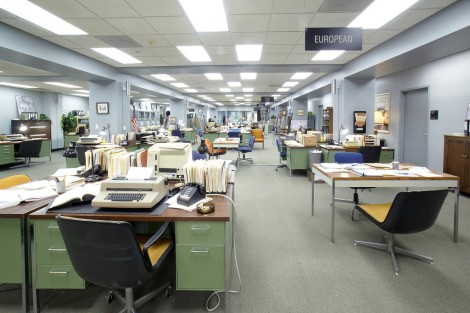
The basement of the historic Los Angeles Times building in downtown L.A. became the CIA bullpen in Argo.

The design team, which included production designer Sharon Seymour, costume designer West, set decorator Jan Pascale, makeup department head Kate Biscoe, and a host of others, was not only faced with re-creating various United States locations but also locations in Tehran, which, for the most part, were shot in Istanbul, Turkey. “Sharon, Kate, and I were all very intent on making it look like it was shot then, not like it was shot now as a period piece,” West says. Because the hostage crisis was so well documented, there was plenty of resource material to draw from, she adds.

In one sense, the nature of the story made it easier to stay away from more comic aspects of ’70s fashion, such as extra-wide lapels and ties, wacky prints, neon colors, and platform shoes. Costume designer West points out that the main characters are Washington, D.C., government workers, more conservative and less interested in cutting-edge fashion than, say, denizens of Los Angeles or New York.

And as in any fashion era, West says, what you see on the street is not always up to date. “We didn’t want it spot-on to be a certain year, there’s a 10-year range,” West explains. “Especially back then; clothes weren’t as disposable in the 1970s.” And individual style often reflects character, not just period: The wardrobe for John Goodman’s character, Hollywood makeup artist John Chambers, is deliberately frozen in the 1960s.

West and her team did strive to reflect the less flashy aspects of period dress, including the color palette (in 1979, brown, burgundy, rust, and navy were the new black), as well as types of fabric, including lots of corduroy. Plus, she added, polyester was a bigger part of the picture then than now. And don’t forget plenty of hair, including mustaches and sideburns, for men: West jokes that there was no “manscaping” back then.

Although glasses are usually considered props and handled by the prop department, Affleck was such a stickler for detail he asked the costume department to oversee their acquisition. West commissioned frame designer Allyn Scura of Sebastopol, with whom she had worked on The Curious Case of Benjamin Button, to create exact replicas of the oversized spectacles worn by some of the real six houseguests.

At Los Angeles costume shops, West and her team were able to find many authentic period clothing items. For clothing that had to be made, they shopped for vintage fabrics because newer fabrics photograph differently. That was especially important because the movie uses real news footage from the period, so the audience’s eye is constantly comparing new filmmaking with period reality.

A particularly painstaking example of fabric obsession: Creating the many chadors worn by the women of Iran. “The women of Iran had been wearing Western clothes, because the shah had been encouraging it, but they all had to go back under the black chador, which became known as the ‘flag of the revolution,’” West says. “But they were running out of black fabric in Tehran, so women were dyeing tablecloths, bedspreads, and over-dyeing printed fabrics with black. (In Istanbul), we found a man who had access to some vintage black fabric that had been exported from Iran to Turkey. He was able to give it to us.”

The fact that Istanbul stood in for Tehran also proved a lucky break for the production designers. For example: A Los Angeles home in Hancock Park stood in for the Canadian ambassador’s home, but some of its features, including fixtures, were too updated for 1979. But fixtures from the right period were still being used in Turkey, Seymour says. “We shipped light switches and outlets from Istanbul to L.A.”

A number of Southern California locations were used: The embassy compound and interiors were shot at the Veteran’s Administration, and downtown’s Los Angeles Times offices stood in for CIA interiors. Ontario International Airport was transformed into Tehran Airport. The Warner Bros. lot in Burbank became the home of Studio Six Productions, the entity behind the phony movie—but the logo on the water tower was changed back to Burbank Studios, as it was then.

The locations weren’t so hard to find, but to furnish them, the production designers tapped a resource they would not have had in 1979: eBay. Because this is Hollywood, it wasn’t too hard to find vintage movie-set equipment, but try finding enough matched typewriters for a CIA office, a real Star Wars figure for a little boy’s bedroom, or 30-year-old TV sets that could be rewired and used to play vintage news footage. “It’s quite a long time ago, but not long enough ago that everything’s antique—it’s thrift-shop stuff almost,” West says. Affleck says a major debate ensued over whether his character would have a telephone answering machine in his apartment.

But why such attention to authenticity for an era many audience members have either forgotten or never knew? “I think all those details add up,” West says. “I think everything we do is part of the subtext of what the story is.”u

Behind The Scenes On Silver Linings Playbook

Paul Brownfield is an AwardsLine contributor. This article appeared in the Dec. 12 issue of AwardsLine.

The least saleable aspect of David O. Russell’s Silver Linings Playbook is also one of its central themes: obsession.

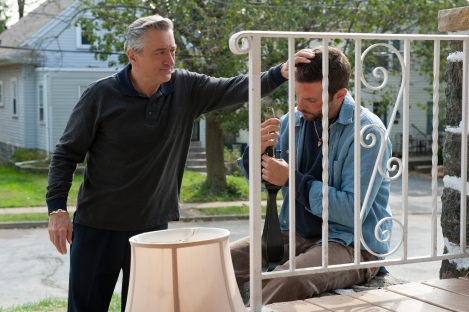
Pat Solitano, the lead character played by Bradley Cooper, is bipolar and manically fixated on getting his estranged wife back. Pat’s father, played by Robert De Niro, is a would-be bookmaker whose OCD behaviors (and his love) get projected onto his gambling and his diehard devotion to the hometown Philadelphia Eagles.

Robert De Niro, left, plays Pat Sr., father to Bradley Cooper's character in Silver Linings Playbook
Robert De Niro, left, plays Pat Sr., father to Bradley Cooper’s character in Silver Linings Playbook

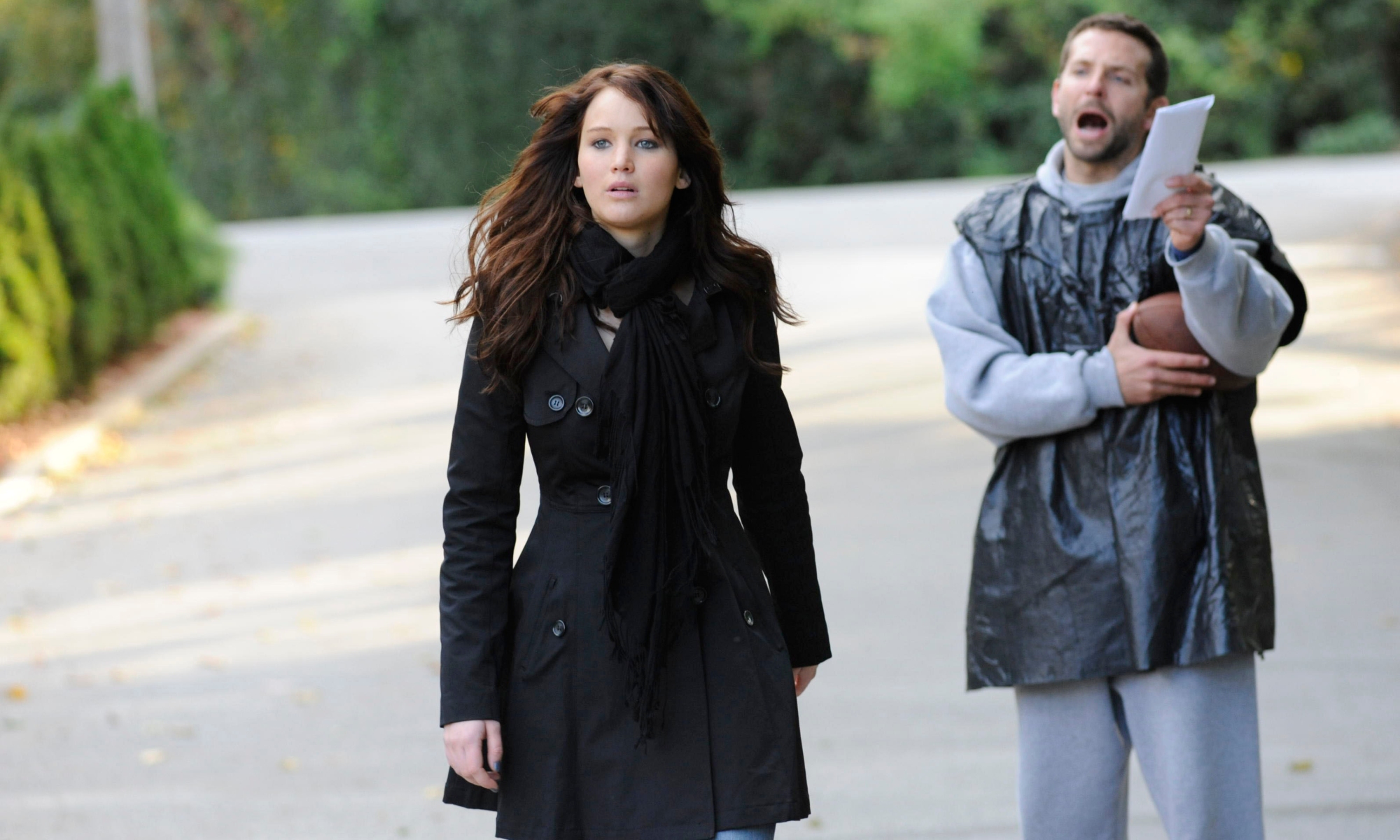
As the film begins, Pat is being released from a psychiatric hospital and moving back into a kind of halfway house—his childhood bedroom. De Niro spends much of the film in Eagles green, trying not to notice his son’s psychosis, which involves long runs through his neighborhood wearing sweats and a trash bag, while Pat’s mother, played by Jacki Weaver, tiptoes through the minefield created by her husband and son.

This is, in other words, prime Russell territory. The setting of Silver Linings Playbook, a no-frills, middle-class neighborhood in Philadelphia, has echoes of Russell’s last film, The Fighter, which evoked working-class Lowell, MA.

Russell calls Silver Linings a cousin to the world of The Fighter. He shot both films on similar 33-day schedules. His budget on Silver Linings was a reported $21 million. Jon Gordon, one of the film’s producers, noted that Russell can even be heard in a few scenes.

“We got most of it out in the post process, but if you listen very, very closely, there’s still a couple places in the movie where you can hear David’s voice in the background,” Gordon says.

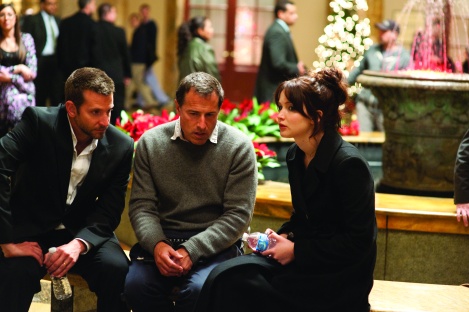
Director David O. Russell, center, with stars Bradley Cooper and Jennifer Lawrence on the set of Silver Linings Playbook,

This fits Russell’s image as a director who himself wades into the emotional muck he means to bring out onscreen. The world of Silver Linings Playbook is not as hardened or volcanic as the world of The Fighter, though there are still verbal—and a few physical—punches thrown, including by Tiffany (Jennifer Lawrence), the widow of a cop with whom Pat forges a connection.

What resonated for Russell when he was adapting the novel by Matthew Quick, he says, was a personal connection to the relationship between a father with OCD and his bipolar son.

“I liked that it was a very specific world, and part of what makes it specific is that there’s a father-son and a mother-son relationship that I have personally experienced with my own son,” Russell says. “Mr. De Niro doesn’t like to talk about his personal motivation so much, but it was also personal to him.”

Not so long ago, the director of Flirting With Disaster and Three Kings was in a self-described “wilderness period.” He hadn’t completed a film since 2004’s existential comedy I Heart Huckabees. The film that changed Russell’s course, and made Silver Linings Playbook possible, was The Fighter. Russell was only a few months removed from the awards-season fanfare for that film when he began preproduction on Silver Linings, and he attacked the production in the way he made The Fighter: Lean below the line; lots of steady cam and hand-held camera; and “show up and do the best you can.”

The film’s pathway to the screen, in the words of the Weinstein Co.’s Donna Gigliotti, had “luck and serendipity on its side.” The novel had been optioned by Sydney Pollack and Anthony Minghella, producing partners who had a first-look deal with Weinstein. They in turn gave the book to Russell to adapt. At the time, his son was 13, and he had recently divorced.

“I needed to work, I needed to write something, and I needed to make a living. And I also really responded to the material, so it was a matter of having the tone right,” Russell says. “You had to not stop working on the tone all the way through the editing process. The key to the whole thing is to keep it real, is to keep the people’s emotions committed and real.”

Early in 2008, Pollack and Minghella passed away within a few months of each other. Michelle Raimo, another producer attached to Silver Linings, was named president of Sony Pictures Animation. The script was languishing, Gigliotti explains, until Raimo urged her not to let Silver Linings fall by the wayside.

At the time, Gigliotti was in the midst of an Oscar campaign for the Weinstein Co.’s The Reader. By then, Russell had gone on to make The Fighter, after which the writer/director was suddenly a hot commodity again. “And thus,” Gigliotti explains, “there was new life in the project.”

It is the kind of movie—part family drama, part romantic comedy, not easily reduced in a trailer—that doesn’t come out of Hollywood with regularity.

“Studios used to make movies like this, and they don’t anymore,” Gigliotti says. “They’ve simply ignored the films that are adult-oriented and in that wheelhouse of $20 million to $40 million.”

Asked about reports that Silver Linings was originally to have starred Mark Wahlberg and Anne Hathaway, Gigliotti says that by the time the film got off the ground, Wahlberg had a scheduling conflict with the action-thriller Contraband, and Hathaway had a commitment to the Batman movie The Dark Knight Rises.

In their stead came Bradley Cooper, best known for The Hangover franchise, and Jennifer Lawrence, Oscar-nominated for her performance in Winter’s Bone but not yet the Hunger Games star.

“It’s funny,” Lawrence says. “I had just worked with Gary (Ross) on Hunger Games, who worked in a completely different way from David, no better, no worse. I’m always slightly embarrassed, as I don’t have any kind of acting background. It’s a silly thing to say, but you work with actors who talk about different methods, and I never had that and it’s a worry of mine because I don’t know technically what I’m doing. Any moment I could show up on set and blow it. That was the first movie that I felt like it was an advantage, because I felt so open to working with—not so much an advantage, but a blessing—any kind of director. But it was so easy with him, I understood him.”

Particularly for Cooper, the film would require that he stretch himself as an actor.

“When I read the script—I think it was probably sort of my defense mechanism—I just sort of thought, ‘Ah, I’m not really right for this,’ which is kind of counterintuitive because I’m from Philly,” Cooper says. “I’m obsessed with the Eagles, I’m Italian-Irish, my parents grew up in households very similar to (Pat’s family), my grandparents lived like that. I grew up basically with my grandparents.”

Watching Cooper play the conceded groom in one of the actor’s early Hollywood roles, 2005’s Wedding Crashers, Russell saw a “palpably angry individual” otherwise being used to play a comedic heavy.

Sure enough, Russell says, Cooper told him he had been an angrier person then. “There were substances and a lot of vulnerable emotions that he was hiding behind anger,” Russell recounts. Inside of five minutes of their meeting, Russell thought Cooper was a “much more vulnerable and interesting person than I’ve seen him be in cinema.”

Russell drew other parallels between Cooper and the character he plays: Both lost weight by way of remaking themselves, and both were hungry to be reintroduced to their respective communities.

“The hunger of Bradley to do this role, the hunger to step up as an actor and to do whatever it took is a wonderful thing for a director, and it mirrors the character’s hunger to be reintroduced to his community. They’re both in a way being reintroduced.

“That’s why I was conscious of starting the film on Bradley’s back,” Russell continues, referring to the movie’s opening scene, in which the camera is trained on Cooper as he is about to leave the hospital. “It’s not the first time I feel I’ve been down that road, in the sense that I feel like people thought they had a reductive idea of Amy Adams. When I told them she was playing a very tough, strong, sexy bitch in The Fighter, people were extremely skeptical. And I said, ‘Well, see the movie.’ ”

Q&A: Tony Kushner on Lincoln

Mike Fleming Jr. is Deadline’s film editor. This article appeared in the Dec. 12 issue of AwardsLine.

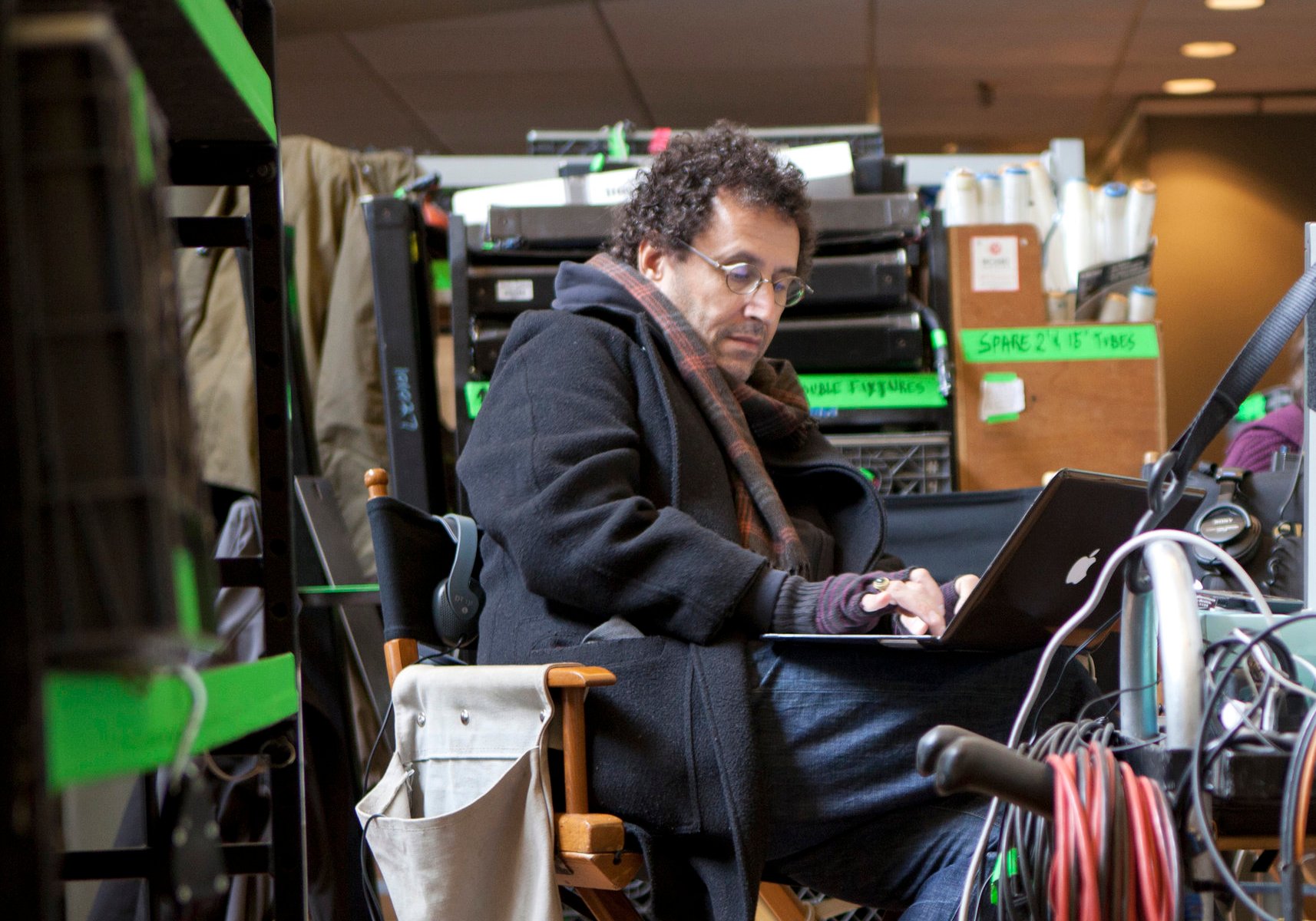
Whittling down the 56-year life of a landmark U.S. president to a feature-length screenplay is a daunting task, and playwright Tony Kushner initially turned down the offer to adapt Abraham Lincoln’s story for the big screen for Steven Spielberg, even after their Oscar-lauded collaboration on 2005’s Munich. But if there’s one writer who can effectively generate emotional drama against a political venue, it’s Kushner, whose Pulitzer Prize-winning seven-hour-long Angels in America play dramatized the AIDS crisis amidst the complex attitudes of Reagan-era times. While length worked in Kushner’s favor during Angels, on Lincoln it was the rock that he pushed up a hill. But after conferring with Spielberg, Kushner soon found the cornerstone that would condense his first 500-page draft down to a 150-minute film: Lincoln’s political fight to get the 13th Amendment to the U.S. Constitution pushed through Congress while the Civil War lingered.

AWARDSLINE: What was the biggest challenge you had in terms of focusing on a part of Lincoln’s life and keeping this feature length?

TONY KUSHNER: It very easily could have been a miniseries. There were a lot of challenges in that regard. It was just an astonishing amount of really incredibly dramatic historical material. By the time I finished doing my research, I could pretty much make a miniseries out of any weekend Lincoln was in the White House. And I know that is not in any way an exaggeration. More than any other moment in American history, (the Civil War) is a gathering of all our country’s central themes. My goal from the beginning was to not make a bare-bones outline of life in his administration. I wanted it to be a drama dictated by the working out of contradictions and conflict rather than a faithful recounting of all the high points in Lincoln’s life. It was very important that we not try to cover too much terrain, rather dramatize it in a small moment. The expanse of time itself defuses a certain amount of dramatic tension.

AWARDSLINE: Why didn’t you say yes to Lincoln right away? Was Munich a tough one to crack as well?

KUSHNER: Not at all. I really loved working with Steven on Munich, and it was hard in certain ways, but I just thought, “How do you write a character named Abraham Lincoln with anything other than an immortalization that you know? And who’s going to play him? And is Daniel Day-Lewis available?” I was told that he wasn’t interested in playing Abraham Lincoln at that point, and it just seemed like it was fraught with sandtraps and pitfalls and improbabilities. I feel even more strongly now than I did six years ago that Lincoln is one of the personalities like Mozart or Shakespeare—real genius is a word that I don’t use loosely or lightly—somebody who is capable of things that are actually beyond great. If you set your goal as explaining what they did and how they did it, the minute you’ve succeeded in doing that you’ve failed because you couldn’t possibly have gotten it right. You can’t explain how Mozart wrote Don Giovanni or how Keats wrote To a Nightingale or how Einstein came up with the Theory of Relativity. If we could figure it out, we could do it. Lincoln is, without any question, the greatest political leader this country has ever had but also one of its greatest writers. And, according to pretty much all accounts, a rather astonishing human being.

AWARDSLINE: What was the most frustrating part of the six years you worked on the Lincoln script?

KUSHNER: The first two years were spent around the fall of 1863, which is when Salmon Chase, the Secretary of the Treasury, began to really openly campaign for the Republican nomination again with Lincoln. I was going to start there and go through the end of April of ’65. I wrote about 100 pages and got as far as Dec. 25, 1863. I thought, “OK, there has to be some way to condense this material.” Every time I tried, I wound up pretty much around the same thing. I don’t think I ever got into 1864. And there’s a vast amount of stuff that happened in 1864 that you just couldn’t skip over. Steven was waiting and I said to him, “I just don’t know what to do. I don’t how to make this a feature-length film.” I was hoping he would say “Well, let’s do it as a miniseries,” but he wanted to do it as a feature-length film. So during the writers’ strike when I wasn’t writing, I put it away, and I had my suspicion that something happened because as soon as our strike was over, I called Steven and asked, “What are we going to do? Shall we just drop this?” And he said, “Why don’t you come up and talk about it? We’ll talk through all of the material and see if we can figure something out.” Two days before I was to go see him, I had a little eureka moment and thought in the last four months of Lincoln’s life there were several immensely dramatic incidents. I went to L.A. with the outline, which Steven thought was still long. I started condensing it and didn’t get very far, so I just took a deep breath and started writing in May of that year, then worked for about eight weeks and produced a 500-page first draft. At some point we eliminated a couple of months and started focusing on the beginning of the end. What Steven was caught up in from the very beginning was the battle behind the scenes for the 13th Amendment. And the more I worked on it, the more I realized that in a way, without any stretching of history, it is a kind of perfect microcosm of what Lincoln contended with during the entirety of the war.

AWARDSLINE:When you turned Angels in America into this big HBO project, was that 500 pages, more or less?

KUSHNER: Angels was probably less than that because it’s seven or eight 60-page scripts. I don’t remember. But I think that we figured out that if Lincoln was a miniseries, it would have been about 10 hours.

AWARDSLINE: What quality allows you to spend six years on a project like this?

KUSHNER: It takes me a very long time to get ready to write and feel ready to write, after which I’m pretty fast. One of the things I love about my job as a playwright or as a screenwriter is that I get to do a lot of research and a lot of thinking and taking a lot of notes before I turn it in. It is a long time to spend on a screenplay. I certainly spent at least that much time on Angels. Most of my plays have taken two or three or four years. But it sort of takes the time it takes. I had never intended to write anything about Abraham Lincoln, so this kind of came out of nowhere for me. I knew that I was going to be handing over a good portion of my adult life to this and that it was going to be tricky.

AWARDSLINE: Was there anything you learned from working with Spielberg on Munich that prepared you to take on something like this?

KUSHNER: Certainly. When I did Angels in America with Mike Nichols, I’d never written a screenplay, I’d never been on a film set before. Mike gave me some incredibly valuable lessons in how to work on a screenplay, and I learned an enormous amount from Steven in terms of screenwriting. I sat behind him the entire time we did Munich, so by the time we were done, I felt I had really learned a lot. I think there’s a certain way in which Munich and Lincoln are connected in that both are sort of about due process and legal versus nonlegal means of getting what you want. Munich asks some questions that needed to be asked and always need to be asked about a policy of targeted assassination for the national and international context. And Lincoln is an investigation. It seemed to me that in a couple of ways the story of his battle for the 13th Amendment in January of 1865, there was a story about legal and quasi-legal manipulations that he felt were necessary to get what he needed. I see no evidence that Lincoln really strayed over the line into illegality. There are a lot of people who criticize him for martial law and for suspending habeus corpus and closing down newspapers. He made some tough decisions, and there was certainly no question that had he lived, the courts would have had a field day. But he struggled a lot because the Constitution doesn’t define war powers: You have them but (it) doesn’t say what they are.


Finding The Right Backdrop Was Key For Promised Land Script

Ari Karpel is an AwardsLine contributor. This article appeared in the Dec. 19 issue of AwardsLine.

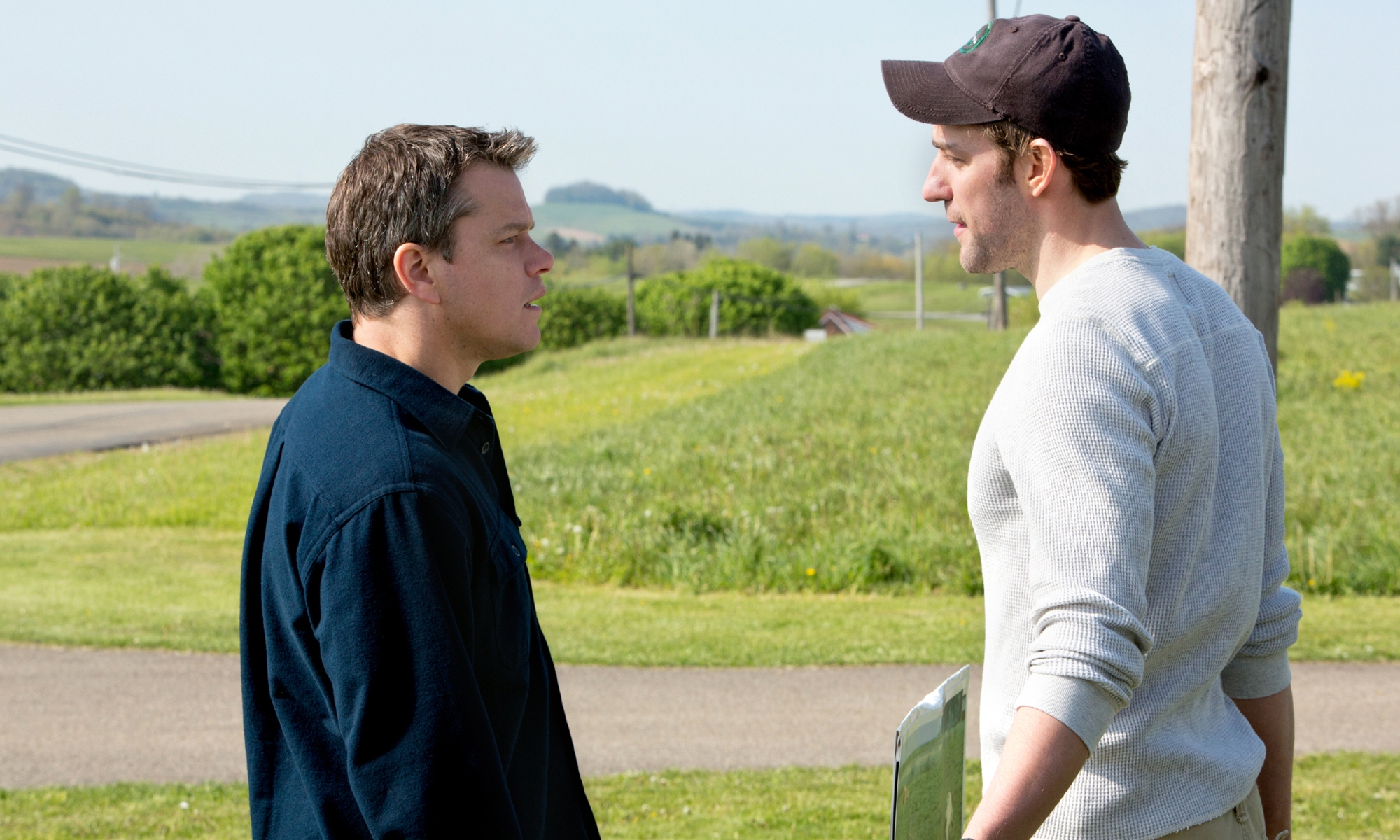
Matt Damon and John Krasinski are well aware that Promised Land is facing what Damon deems “an uphill climb.” The film, about a community confronting the rock-and-hard-place decision of whether to frack or not to frack—that is, whether to allow a major corporation to come in and drill for natural gas in exchange for millions of dollars and, potentially, the townspeople’s physical health—faces a marketing challenge that teeters on the same fine line Damon and Krasinski walked while writing its screenplay.

“It’s a minefield,” says Damon, mindful of the taint that can adhere to a movie thought of as “an issue movie.” “You can’t get too heavy-handed, and it can’t feel like it’s some polemic.”

And yet that hardly compares to the ups and downs he and Krasinski faced in getting the movie off the ground.

It all started with Krasinski, who wanted to write a screenplay about “some sort of abuse of power in…the green energy movement.” The actor, best known as Jim Halpert on The Office, had previously written and directed 2009’s Brief Interviews With Hideous Men and starred in Away We Go, written by Dave Eggers, who also consulted on the film. “I brought it to Dave because these are issues close to his heart, too,” Krasinski says. They hashed out characters and a story, set against the backdrop of the wind-farming industry. (Eggers has a “story by” credit.)

Krasinski then took the idea to Damon, who had just finished working with Krasinski’s wife, Emily Blunt, on The Adjustment Bureau, and was looking for a movie that would be his directorial debut. They decided to write it together. Damon, who hadn’t written a script since he collaborated with Ben Affleck on Good Will Hunting (he is also credited with writing 2002’s Gerry, a movie Damon says is mostly improvised), says he can never find the time. “It takes a lot of time to write. I’m so busy, and I do need a partner to write,” Damon confesses.

They hired a news reporter to find a story they could fictionalize. The reporter produced “mountains of research,” says Damon, which they used as the basis for the script. When they were done writing, he and Krasinski traveled to upstate New York to scout locations. There they met people who thoroughly debunked the narrative. “It was one of those situations where the reporter came back with the story we wanted to hear,” says Damon, who thought they had reached an impasse. “But after a few horrible days, I read it again, and I called John and said, ‘I love these characters!’ ”

So the cowriters transplanted the characters to a mountain in Alaska, and they set their story amidst salmon fisheries being poisoned by run-off from nearby copper mines.

But that just didn’t work. “To John’s credit, he wouldn’t give up,” says Damon. “I was thinking, ‘This is dead, he just doesn’t know it.’ ”

Krasinski saw a 60 Minutes segment called “The Shaleionaires” and was inspired to do a pass of the script on his own, this time about a community dealing with fracking. He brought the draft to Damon in Vancouver, where the actor was shooting Elysium, a visual-effects-heavy movie set to come out next summer. “I realized we had something much better than wind farming,” says Damon. “Because the stakes are so high. It’s not really a choice—between losing your family farm or not.”

When Damon and his family moved to Malibu to shoot We’ve Got a Zoo, Krasinski went to their house every weekend where they would hammer away at the script, empowered by their new subject matter.

At the end of 2011, Damon was doing press for Zoo and planning to direct Promised Land in the new year—until he had a change of heart. “I was done with all my work for the year and I looked at the reality: I just could not do it,” says Damon, who couldn’t imagine spending so much time away from his family again, this time to direct, which would mean longer hours and weeks in prep and post.

“It was like someone telling you Christmas is not happening this year,” recalls Krasinski.

And then a Christmas miracle occurred. Damon was heading to Florida for a much-needed vacation with his family. “It was that moment on the plane when they’ve told you to turn off your phone, and you’re surreptitiously sending emails,” says Damon, who got one out, with the script attached, to Gus Van Sant, who had directed Damon’s first script, Good Will Hunting.

By the time Damon landed, Van Sant had agreed to direct the film. “I like to joke that as a producer I clearly know what I’m doing: I fired myself and replaced myself with Gus,” Damon says.

The movie went ahead, but not without some measure of caution. In speaking about Promised Land, everyone involved had long stuck to talking points that portrayed the movie as being about a community that comes together in a crisis. “Once it came out that it was anti-fracking,” Krasinski says, “it’s hard to shake that until people see it.”

Q&A: Chris Terrio on Argo

This article appeared in the Dec. 12 issue of AwardsLine.

Hearing that an Oscar-winning screenwriter has just signed on to direct the highest-profile script of your career could be somewhat nervewracking. But for Argo’s Chris Terrio, working with director Ben Affleck was made easier because of Affleck’s writing background. “At the beginning, you’re slightly defensive, thinking, ‘The director’s going to come kidnap the baby and carry it away,’ but there was zero of that. From our first conversation, it was just us geeking out about how we could make every scene better,” Terrio recalls about working on the film. Terrio is enjoying the experience of watching audiences see his first major-studio project, all while learning the ropes of awards season as a serious writing contender. Terrio recently spoke with AwardsLine about the complexities of researching the script and what he learned from working with Affleck.

AWARDSLINE: Were you familiar at all with the Argo story when Smoke House’s Nina Wolarsky first called you about writing the script?

CHRIS TERRIO: Of course I knew something about the Iran hostage situation, and I had always been curious about it and had read various books, but no, I didn’t know anything about Argo. I had read Tim Weiner’s Legacy of Ashes: The History of the CIA, and that book briefly mentions it, but I think I read it without ever thinking too much about it. One of the few people in that book that comes off well is (Argo plot architect and CIA agent) Tony Mendez because that book is (about) a litany of mistakes that the CIA made; in fact that New York Times writer is not very popular at the CIA.

AWARDSLINE: You obviously started your research with Joshuah Bearman’s April 2007 Wired article, “The Great Escape,” but what other material did you consult for the script?

TERRIO: The Wired article, it’s short, and I credit Josh completely with the clash of worlds depicted in the movie, which is to say Hollywood and the CIA. But if you’re going to write a two-hour movie, there’s tons of research that you have to do that isn’t in the article. I spent probably the whole spring, and even longer, just circling and circling: Read every book that I could find on the 444 days, anything I could about Iran; looked at some Iranian movies from that period, ones made by expatriates. The Iran Hostage Crisis is the beginning of the 24-hour news cycle, so there’s an enormous amount of video footage that you can see at places like the Carter Center and the National Archives and the Paley Center in New York.

AWARDSLINE: How did you go about boiling it down and making sense of the multiple narratives and still feel like you were being true to the story?

TERRIO: Some of it is just instinct and trial and error. There were definitely moments where I worried that I wasn’t giving a comprehensive enough version of this moment in history. As American filmmakers, we can never tell a comprehensive story about the plight of people in Iran at that moment, but the film—without ever losing the forward momentum—lingers a bit to remind you that there are all these unresolved stories. I have to credit Ben with all that. Those stories could be scripted, like the Iranian housekeeper plot, or could just be a closeup of people waiting for their visas at the beginning of the film. Those closeups tell all kinds of stories: There’s a woman who’s wearing a mink stole and has put on makeup and is just sitting waiting for a visa. I look at that closeup, and I imagine her whole history—it’s just a two-second shot but I think at every margin of the story there are these little hints of stories that we’re not telling.

AWARDSLINE: How long did it take you to write the script?

TERRIO: The script was written in a matter of a few weeks after months and months of research, but I think that’s always the way with me. I need to circle something for a long time, and the characters are gradually showing up and taking their places. Finally, by the time I was ready to write, I knew. They had told me what they wanted to say, and I could sort of take dictation, which I know sounds a little crazy, but I’d imagine most writers would say that. You’re afraid every morning when you sit down that the characters aren’t going to show up for work, and sometimes they don’t, but when they do, you’re happy and you write fast.

AWARDSLINE: You’ve directed film and TV—did you pick up anything from Affleck while you were on the set of Argo?

TERRIO: The mood that Ben created. Ben is very easygoing, but that belies somebody who knows what he wants and knows how to get it. Ben’s ability to work with (cinematographer) Rodrigo (Prieto) and quickly get what he wants, know what he needs, and give himself options is a great thing that I picked up. He already is cutting the movie in his head when he’s making it. He immediately has an instinct about when it’s in the can and when it’s not.

AWARDSLINE: What’s it been like being a part of the awards-season machine so far?

TERRIO: I live in New York, so I’ve been at the margins of it, and I haven’t necessarily been in the belly of the beast yet, if it is a beast. It’s just been a rush for me to see people watching the movie and responding to it, but also to capture a little bit of that film-school excitement about movies.

Q&A: Tom Stoppard On Anna Karenina

Pete Hammond is Deadline’s awards columnist. This article appeared in the Dec. 12 issue of AwardsLine.

At age 75, Tom Stoppard is still at the top of his game, and still seeking new challenges in film, television, and stage. The legendary writer responsible for such original theatrical experiences as Rosencrantz and Guildenstern Are Dead, Arcadia, The Invention of Love, The Real Thing, and Coast of Utopia has also made his mark with a slew of memorable movies including Brazil, Empire of the Sun, Billy Bathgate, and his Oscar-winning script for Shakespeare in Love (cowritten with Marc Norman). Now he is partnering, so to speak, with Leo Tolstoy on a risky but thrilling new version of the Russian classic Anna Karenina. Though there are many film and TV versions already in existence, Stoppard was frightened by the prospect of following in their footsteps yet he embraced it.

AWARDSLINE: Why did you want to take on Anna Karenina? It’s a very ambitious project.

TOM STOPPARD: I had no thought about it until I was asked whether I would be interested in doing it with Joe Wright, and I was immediately interested in it. You don’t often get a proposal to do Tolstoy for a really interesting director—that’s easy to say yes to.

AWARDSLINE: Did you have any trepidation about adapting something that had been done so many times before?

STOPPARD: I probably shouldn’t tell you this, but the first thing I did was to watch all the other ones. (Laughs.) And I suspect in screenwriting class, they tell you not to do that, but I was tempted, and I fell. I watched Greta Garbo, and I watched Vivien Leigh, and I watched Sophie Marceau, and about three others. It was immediately clear that, in a sense, the best one was the BBC—it was hours and hours. So that made one think about what does one do (with) two hours? And I got to the thought that one should deal with the subject of love and not worry too much about local government, agriculture, or (Leo) Tolstoy’s other preoccupations with Levin (Domhnall Gleeson). Levin is the character who represents Tolstoy in many ways, and Joe and I talked about this a lot. And I said, “We should just try to make a movie where the word love just keeps dropping in, like a pebble into a pond, and deal with the way that love works.” I don’t mean love between lovers only; I’m talking about Anna’s love for her family—intense love in the novel. That was the guiding track for me.

AWARDSLINE: I talked to Joe Wright after I saw the film in Toronto, and he said he absolutely shot your script. But he also said that he came up with this theatrical device. Were you in on that decision initially?

STOPPARD: He called me up and said, “I’ve got to see you urgently.” This was a few weeks before we went into production, and he came to my flat with this big file, which turned out to contain the storyboards of a lot of the movie. There was a terrifying moment where he said, “I hope you like it, because if you don’t, we can’t do it.” So I felt I had to like it before I saw it, and I was just staggered by it. I was also worried by it, for obvious reasons. But as I turned the pages, I began to understand that it could be an extremely exciting piece of storytelling. When we got to the horse race, for example, I thought, “This is insane, but insanely brilliant!”

AWARDSLINE: In a play, you are going to have interaction with the actors—did you go on set or interact with the actors to talk about your point of view for the film?

STOPPARD: That all happened before there was a set. I was at rehearsals, but once we had done rehearsals, frankly, the writer really doesn’t have a function on the set. If the script is stabilized, then the writer becomes a celebrity tourist visiting the set, trying not to get in the way. It’s very good for the ego, to go visit a film set if you are the writer, because they give you a special chair, and tell you where you can sit to watch the monitor. They make you feel special, but at the same time, they make it perfectly plain that you are irrelevant! (Laughs.) I think that the one time you’re not needed is during production. You are needed again in post—I love to do postproduction. I am good at being shown something and counterpunching. I am in no way a director, but I’m a quite good critic.

AWARDSLINE: Once you got into postproduction, what kind of changes did you see?

STOPPARD: You always end up with too much, so it’s good to be part of the conversation about not just what you can omit, but how you are going to do the grammar of the omission, how you make things continue to work when there’s something missing. It’s your last chance to rewrite. Rewriting isn’t just about dialogue, it’s the order of the scenes, how you finish a scene, how you get into a scene. All these final decisions are best made when you’re there, watching. It’s really enjoyable, but you’ve got to be there at the director’s invitation. You can’t just barge in and say, “I’m the writer.” (Laughs.)

AWARDSLINE: Would you want to work with a director that did not allow you into that process?

STOPPARD: I don’t think I would, actually. It just doesn’t make any sense to me.

AWARDSLINE: Do you have a preference for movies or theater?

STOPPARD: I’ve never actually written an original (screenplay), so the theater is my only original work. I really enjoy great (film) adaptations—you’re given the story and the characters by somebody else. So it’s more like a collaborator, even if your collaborator is dead. The first job always is to deconstruct the piece that you’re working from, the novel, and I find that it’s really enjoyable because it’s a manageable job, it’s not actually a creative job. You can see what you really need and what you don’t.

Q&A: Mark Boal on Zero Dark Thirty

Thomas J. McLean is an AwardsLine contributor. This article appeared in the Dec. 12 issue of AwardsLine.

As both a journalist and a screenwriter, Mark Boal is no stranger to writing about modern soldiers and the wars they fight.

Zero Dark Thirty reunites Boal with director Kathryn Bigelow—both won Oscars for The Hurt Locker—to chronicle the hunt for Osama bin Laden. It’s a subject that made the movie infamous long before its release as pols and pundits accused the White House of trying to bolster its image by granting Boal and Bigelow improper access to classified information about the May 2011 raid that killed the Al Qaeda leader.

While Boal denies the charges—the released documents fail to prove improper access—the movie itself has at last emerged to defy political pigeonholing and throw a surprise shock into awards season. Eschewing policymakers and presidents, Zero Dark Thirty relies on first-hand accounts of events and focuses on CIA analyst Maya, who spends a decade obsessively hunting bin Laden. Like all the characters in the movie, Maya, played by Jessica Chastain, is based on a real person—though not so much so that anyone can identify the real agent.

Speaking with AwardsLine less than a day after Zero Dark Thirty first screened, Boal reflected on the intense process of putting together a complex film under such unusual pressures.

AWARDSLINE: You’ve been telling stories about today’s soldiers and modern wars. What do you find so attractive about these subjects?

MARK BOAL: Ever since 9/11, I found myself interested in chronicling the war and the war on terror and the way that this giant machinery was affecting individuals. As a screenwriter, I’m fascinated by people that put themselves at such great risk. And there’s so many inherently dramatic components—for example, the intelligence community—that make fertile ground for a dramatist.

AWARDSLINE: You were working on a movie about bin Laden’s 2001 escape into the caves of Afghanistan. How far had you gotten on that project and what kind of state was it in when bin Laden was reported killed?

BOAL: We were planning to shoot late that summer.

AWARDSLINE: What was your first thought about the movie when you heard he had been killed?

BOAL: I was thinking about friends I had lost on 9/11, to be honest with you. But eventually I came around and started thinking about it narratively, as a screenwriter, and it occurred to me that I had a lot of work to do and that I’d probably have to throw out years of work.

AWARDSLINE: How did you gather your first-hand accounts? Were you going through official channels or were you tracking down people on your own and using your own contacts?

BOAL: It was a combination of all three of those methods. I certainly went through official channels, the public-affairs offices of the relevant agencies, as any reporter would do. I also did independent reporting, and you just kind of follow your nose and you build what you know one interview at a time.

AWARDSLINE: How quickly did the script come together?

BOAL: I felt like I was working with a gun to my head because I felt a lot of competitive pressure to do it quickly. It was a couple or three months of writing, and another three months of research. I was researching while I was writing.

AWARDSLINE: How much did the script change through production?

BOAL: We shot the first draft, more or less, but I was always tweaking scenes on set. There were no conceptual revisions, really, but once I get a sense for an actor and how the dialogue sounds coming out of his or her mouth, I like to craft the character to what I perceive to be their strengths. Probably not a day went by when I didn’t churn out revisions of existing pages.

AWARDSLINE: A lot has been made in the media of the production getting assistance from the government in researching the movie. How did you approach the government and what kind of assistance did they provide?

BOAL: If you’re trying to do your homework, as I was, the first thing you do is you go directly to the offices that are set up and designed to work with reporters or book authors or screenwriters. That’s what their job is: Communicate the facts and the goals of whatever agency they work for. That relationship between people seeking information and government agencies sharing the information is one of the foundations of this system that we have. What was unusual in this case was we got caught up in an election year and our movie became a chew toy, a talking point in a presidential election campaign. There were all sorts of things that were said about the film that were just not true.

AWARDSLINE: How fictionalized is the Maya character and what are some of the challenges of writing this kind of character?

BOAL: It’s what screenwriters do all the time when they work from life. Part of what astonished me in my research is there were a lot of women involved in this hunt that played a big role, and I just wasn’t aware of that side of the CIA. I chose to tell the story through her eyes because that seemed to be to me the most dynamic and interesting way to do it. You’re also trying to dramatize events to tell a story most effectively. That doesn’t mean the events aren’t true, it just means you’re making them as dramatic as you possibly can. Then there were also things that I did to the character that I’m not going to discuss for obvious reasons to make sure that nobody would be able to watch the movie and draw a dotted line between a character in the film and somebody in real life.

AWARDSLINE: Was it a conscious choice to steer clear of putting politicians in the film except for brief glimpses of TV news reports?

BOAL: That was a creative choice. For better or worse, most of my writing life has been about people that work behind the scenes. I’m interested in finding extraordinary moments in otherwise normal people. Not to say there couldn’t be a great movie about the White House—I’m sure there will be some day, and somebody should write that movie. It just won’t be me.

Adapted Screenplay More Crowded Than Original This Season

Pete Hammond is Deadline’s awards columnist. This article appeared in the Dec. 12 issue of AwardsLine.

When it comes to the written word in this year’s Oscar race, it helps to have sources. While the original screenplay category has a few serious best picture contenders in Zero Dark Thirty, Django Unchained, The Impossible, Flight, The Master, and Amour, it is the adapted category where the action really is. The five top best picture contenders on most pundits’ list of predictions —Silver Linings Playbook (David O. Russell), Les Misérables (William Nicholson, Alain Boublil, Claude-Michel Schonberg, Herbert Kretzmer), Argo (Chris Terrio), Life of Pi (David Magee), and Lincoln (Tony Kushner)—are all competing against each other, making it one of the hottest races for adapted screenplay in years. It is proof positive that either Hollywood is lacking in great original ideas or the most promising material in terms of best picture candidates has come from another medium.

Director David O. Russell, center, with stars Bradley Cooper and Jennifer Lawrence on the set of Silver Linings Playbook,

It is actually a bit of a reversal of a recent trend where the best picture winner came from original screenplays. In fact, the last three films to take Oscar’s most prestigious prize—The Hurt Locker, The King’s Speech, and The Artist—were all original, reversing a previous eight-year trend in which the best picture winners were adapted in seven of those years (Crash’s 2005 shocker of an upset over Brokeback Mountain being the only exception). That, in turn, had reversed a trend in favor of original best picture winners when five of six at the end of the last century had triumphed over adaptations.

Ben Affleck, left, with Argo screenwriter Chris Terrio.

But from the looks of things, the pendulum could be swinging back, which is why writers are seeking out those hot properties to turn into movies. Bubbling under the top list of contenders for best adapted screenplay is an impressive group that includes Tom Stoppard’s take on Leo Tolstoy’s Anna Karenina; Stephen Chbosky’s adaptation of his own 1999 coming-of-age tale The Perks of Being a Wallflower; Ol Parker’s The Best Exotic Marigold Hotel; Ronald Harwood’s Quartet; French import Rust and Bone from Jacques Audiard and Thomas Bidegain; Richard Linklater’s indie hit Bernie; Ben Lewin’s The Sessions; Benh Zeitlin and Lucy Alibar’s Beasts of the Southern Wild; John McLaughlin’s Hitchcock; and a couple of studio tentpoles from big names, The Dark Knight Rises (Christopher Nolan, Jonathan Nolan) and The Hobbit: An Unexpected Journey (Peter Jackson, Fran Walsh, Phillipa Boyens, Guillermo del Toro). There is also Judd Apatow’s very personal original This Is 40,which is an adaptation only in the sense that it covers the further adventures of two characters from Knocked Up, so even Universal is advertising it as the “sort-of sequel.” It really should be in original where it would have a better shot. Adaptation should be only about just that, adaptations.

Leading the parade of originals are likely nominees Zero Dark Thirty, with a script shrouded in controversy from Hurt Locker Oscar winner Mark Boal; Paul Thomas Anderson’s highly ambitious The Master; Wes Anderson and Roman Coppola’s Moonrise Kingdom;Quentin Tarantino’s Django Unchained; John Gatins for Flight; Cannes Palme d’Or winner Amour from Michael Haneke; the emotional and gripping The Impossible by Sergio G. Sanchez; and the French box-office sensation The Intouchables from writer/directors Olivier Nakache and Eric Toledano. Under that top tier of contenders are such disparate films as Arbitrage (Nicholas Jarecki), End of Watch (David Ayer), Promised Land (Matt Damon and John Krasinski),and Martin McDonagh’s Seven Psychopaths, and there might even be a shout-out from the writing branch for Oscar show host Seth MacFarlane’s smash hit comedy, Ted (cowritten with Alec Sulkin and Wellesley Wild). Sometimes there is room for an animated movie to sneak in here, too, and this year’s most likely contender for that slot would be Disney’s clever Wreck-It Ralph from Phil Johnston and Jennifer Lee.

If you’re looking for clues for the likelihood of a nomination for Wreck-It Ralph or even many of the other contenders listed above don’t count on the nominees list from the Writers Guild of America, which will be announced on Jan. 3, a full week before the Oscar nominees are named. The WGA regularly bans animation scripts and a lot of indie projects not produced under guild jurisdiction. In recent years, this has led to a wide divide between the WGA nominees for original and adaptation than what the far more inclusive Academy comes up with. In 2009, only one WGA-nominated original screenplay, Milk,was also on Oscar’s list (it won, though). In 2010, though the two groups agreed on six of the 10 writing nominees in both categories, the eventual Oscar winner for original screenplay, David Seidler’s The King’s Speech,wasn’t even nominated for a WGA honor because it wasn’t made under the guild’s guidelines. Last year, a paltry four out of 10 nominees were on both Oscar and WGA lists. This chasm between the two organizations, despite shared membership, makes it increasingly difficult to predict Oscar nominees based on the preference of the guild, which is quite unlike the strong correlation between Oscar and other guilds like the PGA, DGA, and SAG.

Q&A: Ben Affleck on Argo

This article appeared in the Dec. 12 issue of AwardsLine.

After directing two successful features, Gone Baby Gone in 2007 and The Town in 2010, Ben Affleck has come into his own, perhaps finding greater creative success behind the camera than he ever has as an actor performing in front of it. In fact, the Oscar-winning screenwriter stands a good chance of earning another nom, this time for helming Argo, an almost unbelievable real-life story about how the CIA teamed up with Hollywood to rescue six diplomats stranded in Iran after the Shah’s fall. Affleck also stars in the film, and he’s clearly still passionate about acting. “The director part of me thought it would be too much trouble not to give the actor the part. I’d never hear the end of it,” he says about taking on the role of agent Tony Mendez. He recently spoke with AwardsLine about directing himself and the challenges of shooting the film’s pivotal embassy-takeover scenes.

AWARDSLINE: At the film’s DGA screening, you talked about how it was important for you to foster a bond among the six actors playing the houseguests in Argo. Can you talk a bit more about what that rehearsal process was like?

BEN AFFLECK: I wanted them to get to know one another better and just be more familiar and at ease around one another, and that could only be accomplished really with time exposure. I wanted them to know what it was like on a subconscious level to feel trapped and holed up in a place. So this idea that I came up with was to put them up someplace for a week inside the set. We dressed it and had everything that they would have when we shot: There were newspapers from the period, magazines from the period, and I put in movies from that period that I wanted them to watch, records and a record player—all kinds of things. I didn’t give them much instruction and said, “This is where you have to be,” because that was the circumstance under which the people were (living). They didn’t have any goals other than to sort of stay there and stay hidden. I didn’t know (what) would develop in the rehearsal process, but whatever happened, it was genuine, it was good. Ultimately, I don’t know what happened. It was part social experiment, part reality show with no cameras. (Then) we came, and we set them free. (Laughs.) I knew it was good because they didn’t seem to want to talk about what happened.

AWARDSLINE: Did they leave at night?

AFFLECK: No, they lived there! They slept there. It takes time to develop a sense of humor, shared world views. I just felt like putting them in the bag and shaking (it) up—you don’t know what the pattern of flour and chicken is going to be, but you know you’re going to get some good fried chicken.

AWARDSLINE: The script was completed before you signed on, but you ended up extending the opening sequence before production started. Were there other tweaks that you and screenwriter Chris Terrio worked on?

AFFLECK: There were all kinds of adjustments and back and forth, just work that goes on between a director and a writer. (As) a director who is a writer, I have respect for writers, so I’m less likely to step on an idea or a line. We were both really comfortable telling each other that things didn’t work if we didn’t think they worked.

AWARDSLINE: And Terrio was on set for a lot of the shoot, too, right?

AFFLECK: Yes. Initially I thought, I’m going to get this script and run with it, and do my thing, like I did with the other two movies I made. Then I talked to Chris, and he was so smart and insightful and had done all this research, and so I was like, “This guy would be a huge asset and a great writer, so let’s keep him on.” On my other two movies, stuff had to be rewritten, and I would go off into a corner and puzzle over it. It would take me forever, and I would stay up all weekend. It was so nice to be able to say, “Exactly what the agenda is of the State Department in this scene? Could you rewrite that scene?” and have him come back later with the answer. I felt like I was looking at the back of a test.

AWARDSLINE: How does it work when you’re directing yourself?

AFFLECK: Everyone has a different approach, but I like to shoot a lot of film anyway. I like to shoot until we have a relaxed environment on the set, and I try to schedule that. And I do the same thing for myself (as an actor) that I do for others. I get to the point where I feel relaxed, and then I just shoot a ton of material and make a lot of different choices. (I) try new things and give myself permission to fail and experiment because only that way can you get really successful. I don’t go back and look at the monitor between every take; I wait until I feel like we finally got it right: “Let me stop and look at that last one on the monitor.”

AWARDSLINE: In terms of the location shoots, were there other Middle Eastern locations that you considered?

AFFLECK: We scouted all over the place. There’s the competing concerns of creativity and budget, and that was a pretty close race with this movie. We scouted Jordan, we scouted a couple of countries in North Africa—this was before the Arab Spring. Jordan we would have been OK, but the truth is, it looked very Arab. Persia is very different from the Arab Middle East in terms of architecture and language. Even though we think of them as one big Middle Eastern area, in truth, Persia’s quite distinct. So we looked at Bulgaria, which also happens to be profoundly inexpensive, and then we looked at Turkey. That was the last place we went, and it was also the nicest place.

AWARDSLINE: What was the most difficult scene to pull off in terms of scheduling and budget constraints?

AFFLECK: The (embassy) takeover stuff in the beginning, where we had 2,500 extras, that was really hard to do in Istanbul. We could only afford so much, so it was hard to pay people enough so that they would come out there and work all day. Turkey’s growth rate was 8% last year—it’s not a developing country. You have to pay people real money. And we had to pick people up in buses at one in the morning, get there, get everyone in wardrobe, get them out in the street, give them signs, and teach them how to chant their slogans. In the extras’ holding area, I put our research on a loop, which is images of the actual revolution, so people could get a sense of the anger and the power of the whole thing. They were psyched; the extras got into it. So that was really fun. (But) it was cold, it was raining, (and) it was very hard to keep people around. Of course, it turned out somehow we didn’t have enough food, or we didn’t have as much food as we thought—there were all sorts of problems like that. Meanwhile, I’m worrying about the big shots with the cranes, and as we lose people, I keep making the big shots tighter and tighter. The other issue was that the people who were available to be around all day are the elderly; the younger people are working. So basically, we had a lot of folks who were over 65 in a student revolution. So they made up for it with passion. They were chanting, going nuts. It was ultimately exhilarating, fun, and thrilling and felt like we had a real partnership. I’ve been an extra in, I don’t know, 20 movies, so I feel like I know how it is. I’m trying to make people feel welcome and feel valued.