Themes Of Struggle Link Foreign-Language Film Contenders

David Mermelstein is an AwardsLine contributor. This article appeared in the Dec. 12 issue of AwardsLine.

Fairly or not, European films are widely considered more serious than their American counterparts. Certainly the movies eligible for the best foreign film Oscar this year fit the mold. Several make struggle a central theme, doing so in varied but consistently engaging ways.

Pablo Larrain’s No, from Chile, examines the 1988 plebiscite forced on General Augusto Pinochet, the result of which marked the beginning of the end of his dictatorship. In the film, a gifted marketing executive, Rene (Gael Garcia Bernal), must choose between middle-class comforts and his conscience—a choice complicated by his family’s ties to leftist politics. His boss (Alfredo Castro), who is firmly in league with the pro-Pinochet forces, plays Mephistopheles in this situation, reminding Rene, in no uncertain terms, that the creature comforts he enjoys are by no means guaranteed. Complicating matters are Rene’s shaky relationship with his politically engaged wife, Veronica (Antonia Zegers), from whom he is already separated. All of which leads to the film’s central question: What price bravery?
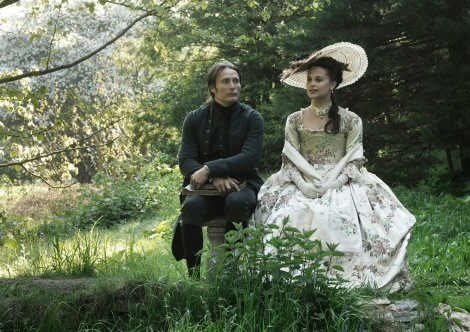
Denmark's official Oscar submission is A Royal Affair, which transports viewers to the 18th century.
Denmark’s official Oscar submission is A Royal Affair, which transports viewers to the 18th century.

Chen Kaige’s Caught in the Web, China’s contender this year, essentially flips the individual-versus-society question as it examines the struggles faced by Ye Lanqiu (Gao Yuanyuan), a mild and attractive executive assistant who is given a grim prognosis of advanced lymphatic cancer. That dire news triggers a chain of events in which the stunned secretary acts rudely on a public bus, and her behavior, captured on a young reporter’s cell phone, creates a cause célèbre, catapulting her to national vilification as “Miss Sunglasses.” This double blow of fate and ostracism is compelling, but Chen is more concerned with turning the lens around, from the individual onto Chinese society. There, he suggests, obsession with technology has reduced public empathy to everyone’s detriment.
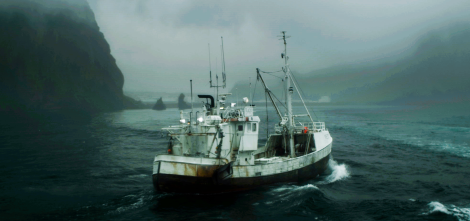
Iceland's The Deep is based on the true story of a fisherman who survives a shipwreck.
Iceland’s The Deep is based on the true story of a fisherman who survives a shipwreck.

Based on real incident, The Deep, from Icelandic filmmaker Baltasar Kormakur, relates the incredible story of a simple but happy fisherman named Gulli (Olafur Darri Olafsson) who finds himself the sole survivor of a sinking ship. Battling nature and the guilt he feels at being unable to save his crewmates, he makes an improbable bid for survival, defying long odds and swimming to safety. Yet doubts confront him once he does, with people—especially those in authority—refusing to believe his death-defying accomplishment. Then, after confirmation of his experience, he is subjected to medical tests, in hopes of finding a scientific basis for his fortitude and good fortune, so unwilling is the establishment to accept extraordinary actions from such an ordinary man.

Struggles of a strictly private nature lie at the heart of Michael Haneke’s Amour, a French-language film flying the Austrian flag. Centering almost entirely on an aged couple (Jean-Louis Trintignant and Emmanuelle Riva) who must suddenly come to grips with infirmity and—by implication—mortality. Though the much-lauded and singular Haneke would not seem an obvious choice for such a picture, his utter lack of sentimentality pierces the essence of what it means to grow old. Here, Riva must contend with the ravages of a stroke while Trintignant watches his life partner disintegrate before him, powerless to do much more than offer limp comforts.

Transporting viewers to 18th-century Denmark, Nikolaj Arcel’s A Royal Affair uses a historical romance between King Christian VII’s wife, Caroline Mathilde (Alicia Vikander), and the king’s physician-cum-chancellor, Johann Streunsee (Mads Mikkelsen), to explore the challenges facing enlightened nobles attempting to improve a backward nation. Beneath the rustle of damask and flickering candlelight, Arcel asks eternal questions regarding a nation’s leaders and their responsibilities—questions made all the more pointed when the populace is too ignorant to embrace its own interests. This particular tale did not end well for those involved, their struggles and sacrifices made apparently in vain. But history takes the long view, which Arcel clearly appreciates in his touching coda.

Said Ould Khelifa’s Zabana! also takes a page from history to appreciate the short life of the Algerian freedom fighter Ahmed Zabana, whose execution helped bring about Algeria’s war of independence from France. And though Australia’s entry for an Oscar this year, Lore, is fictional, its German-language story is grounded in a historical subject that film lovers never seem to tire of: World War II and its consequences. In this case, the protagonist is teenage girl whose parents were ardent Nazis.

Such films as these aren’t are always shortlisted, let alone award winners, of course. Last year’s outstanding A Separation, from Iran, delved deeply into matters of perception and truth, but on an intimate scale. Still, the Academy clearly has a soft spot for foreign films that tackle big issues in which struggle figures prominently. Haneke’s The White Ribbon (2009), from Germany, is a perfect example, with its implicit societal indictment. And so is Florian Henckel von Donnersmarck’s The Lives of Others (2006), also from Germany. Both contend with man’s eternal battle to come to terms with both himself and the society in which he lives. And these are struggles to which we can all relate.
Behind The Scenes On The Intouchables

Diane Haithman is an AwardsLine contributor. This article appeared in the Dec. 12 issue of AwardsLine.

On a Saturday morning in early December, Weinstein Co. chief operating officer David Glasser was facing a very busy day: A noon screening of his company’s critically acclaimed Silver Linings Playbook, followed by a 3 p.m. screening of Weinstein’s Christmas Day release Django Unchained, then an evening at the Academy of Motion Picture Arts & Sciences’ fourth annual Governors Awards. Until the Feb. 24 Oscar ceremony, “Saturdays and Sundays are not my own,” the executive jokes.

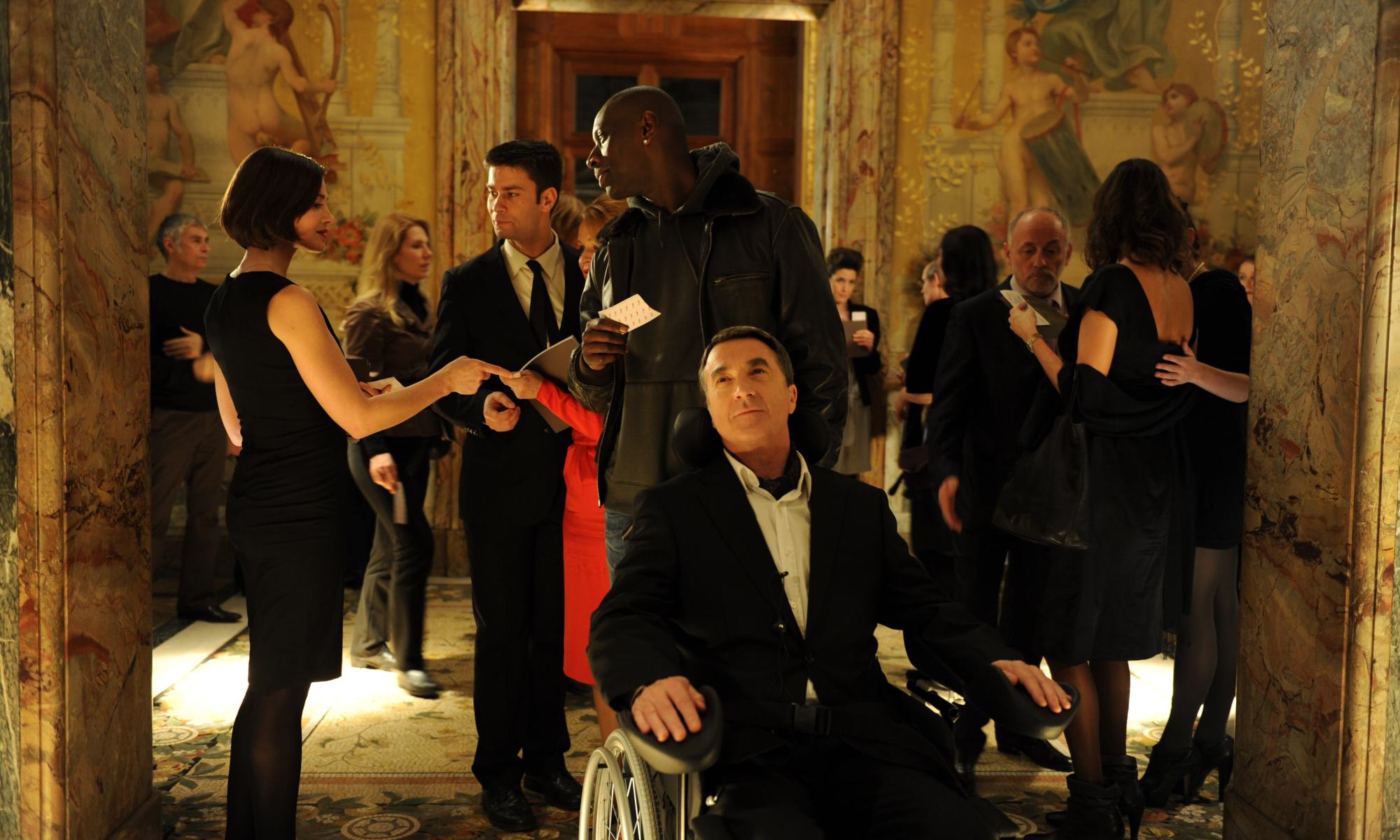
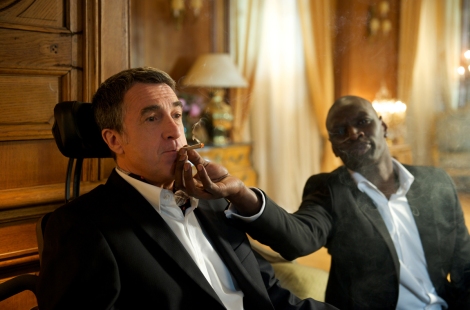
François Cluzet, left, and Omar Sy in The Intouchables.

But in between such big events involving big movies, it somehow seemed fitting that Glasser would carve out a little chunk of time to talk about a small but equally important film executive-produced by the Weinstein Co.: The Intouchables.

This $2 million French film, based on the true story about the bond between a wealthy quadriplegic (played by François Cluzet) and the fun-loving younger man from a housing project (Omar Sy) he hires to take care of him, has earned more than $400 million at the boxoffice worldwide and is the official French entry for the foreign-language film Oscar.

In fact, Harvey Weinstein and his team like The Intouchables so much that they are producing an English-language remake with a different cast in the United States. Glasser predicts the script will be completed within the next two or three months, and the film will be produced in 2013 for planned release in 2014.

Because The Intouchables (that’s French for “untouchables”) is being entered in the foreign-language category, it is not in the running to repeat the Weinstein Co.’s 2012 best picture win for another French film, The Artist. Still, the company seems to have high hopes: The Intouchables was among the first DVD screeners to be shipped out to Academy members in early October.

Glasser says the foreign-language category was more appropriate than a best picture entry for this film. “Look, with The Artist we were much more involved. This was their movie,” Glasser says, referring to writer/directors Eric Toledano and Olivier Nakache and the producing team of Nicolas Duval-Adassovsky, Yann Zenou, and Laurent Zeitoun. “And it wasn’t like (the Weinstein Co.’s 2011 winner) The King’s Speech, where we had made it. When they put it in as France’s foreign-language film, we were fine with that. It felt like a natural fit for the movie.”

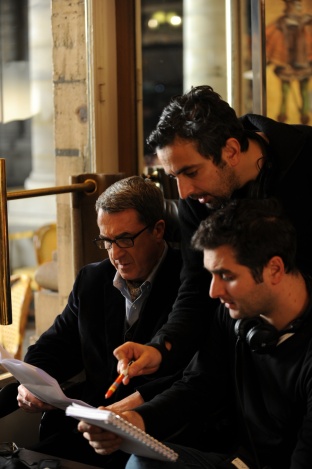
Writers and codirectors writer/directors Eric Toledano, center, and Olivier Nakache, right, on the set with François Cluzet

While the submission category is different, The Intouchables, like The Artist, was discovered by Harvey Weinstein in unfinished form. In the case of The Artist, Weinstein flew to France to see a rough cut of the film before it was presented at the Cannes Film Festival. In the case of The Intouchables, as codirector Toledano describes it, a Weinstein Co. representative was in the crowd of potential film distributors in Cannes who saw an eight-minute trailer for the unfinished film about six months before its release in France.

“(The Weinstein representative) asked us to show it to Harvey Weinstein, and we were so excited, obviously,” Toledano says. “When Harvey saw the trailer, he said, ‘I want to see the movie.’ The movie was not finished. One month later, (when) we had the first edit of two hours, he decided to come to London, where we showed him the movie. And he decided to buy it, which was wonderful for us.”

This process is typical for Weinstein, Glasser says. “A lot of times we buy something at script phase, or we’ll see a little footage and buy it,” he says. “We bought Iron Lady that way,” Glasser adds, referring to the film that netted Meryl Streep a best actress Oscar in 2012 for her portrayal of British Prime Minister Margaret Thatcher.

And what did the Weinstein Co. see that made them want to bet on The Intouchables? “We love French movies, as I guess you know—we bought four this year alone (including) Haute Cuisine, “ Glasser says. “In eight minutes you felt that kind of magical, warm, very honest relationship between these two guys.”

Adds Glasser, “I think in a marketplace of $100 million, big picture, big studio movies, we’re in that nice, perfect place for great cinema, great stories. They could be a $2 million movie or a $40 million movie. You bring something nice to the marketplace. And there’s a little less competition.”

The filmmakers were inspired by the documentary A la Vie, a la Mort, about the close relationship of Philippe Pozzo di Borgo, who became a quadriplegic after a paragliding accident, and his assistant Abdel, who hails from a housing project. In the movie, the Algerian-born Abdel is re-created as the Senegal-born Oriss to make the role appropriate for actor Sy, 34, who has played roles in other films for the two directors.

Cluzet met and studied the behavior of the real Philippe, but Sy did not meet the real Abdel until after the film was completed. Toledano says the real Philippe was willing to speak about his situation, but the real-life Abdel was less trusting. “He was so suspicious that we wanted to do a movie about his life,” Toledano says. “At first, he wanted to stay far away from everything. He expected to see the movie, but that’s all he wanted to do.”

Plus, Toledano adds, while he admires the real Abdel, he’s just not as funny as Omar Sy. “I don’t think the public could love him as they do Omar.”

Sy, who honed his performing chops as a comedian, also preferred not to meet Abdel, whom he finally encountered on the night of the film’s premiere. “It was important for me to keep space for me to create,” Sy says. He adds that, because he is a comedian and does impressions, it would have been all to too easy for him to fall into doing an impression of Abdel rather than creating his own character.

The opposite is true of Philippe, Toledano observes. “Philippe Borgo, he is a very smart guy, very highbrow. It was really important for the actor to make a meeting, because Philippe has a special look. When Omar came with us to the meeting, he said something very interesting: ‘He can catch you with his eyes.’ ” That was also Toledano and Nakache’s first direction to Cluzet: “He has nothing but his brain, nothing to express his feelings but his eyes. You have to act this movie with your eyes,” Toledano says.

The directors and Sy acknowledge there are currently several movies getting Oscar buzz that deal with characters with severe physical handicaps, including The Sessions and the French-Belgian film Rust and Bone, starring Marion Cotillard as an aquatic animal trainer who loses her legs in an accident. All three believe that there’s something in the global zeitgeist of bad news and a struggling economy that makes today’s audience want to cheer for the underdog.

Nevertheless, Toledano and Nakache believe the key to The Intouchables’ success is that it’s a comedy, more inspired by American buddy movies than tales of overcoming disability. “We made this movie because of the story between two men,” Nakache says. “For us it’s an amazing story, we never expected such a huge tsunami. The thing is, if this movie changes one person, inspires the life of one person, we have achieved our goal.”